
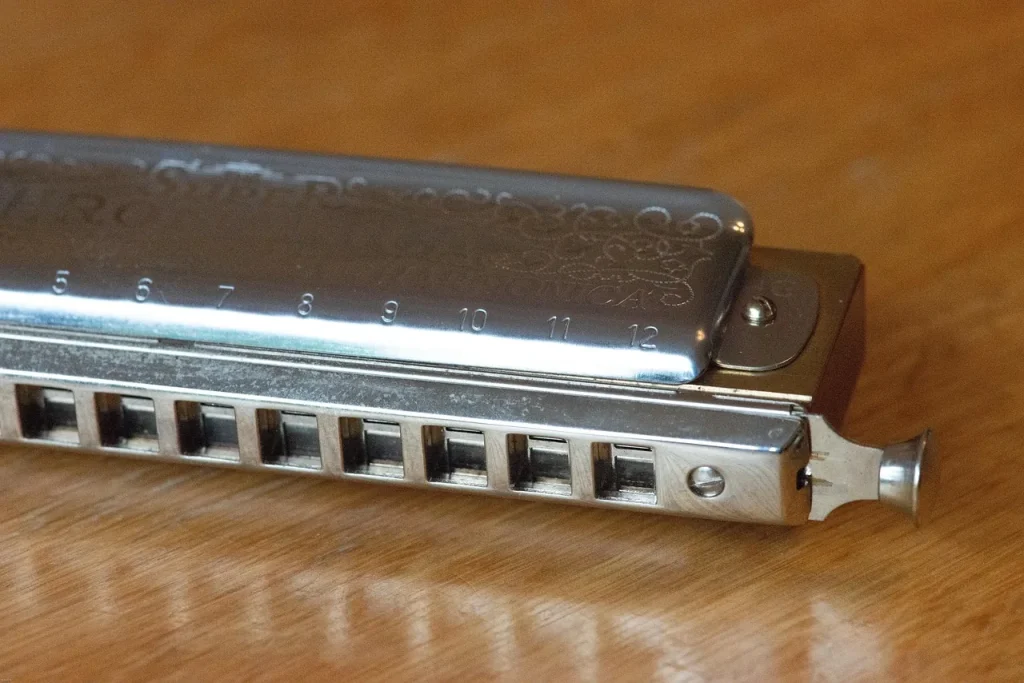
This guide will help you make the right choice between two popular formats. It compares range, handling and practical use according to your skill level and budget.
The models differ in range: 12-hole versions provide a practical range for learning and studio work, while 16-hole versions offer a wider range that is useful in concert. The Hohner Chromonica 270/48 C-Deluxe, Hohner CX-12 Jazz and C.A. Seydel Söhne Symphony Grand Chromatic Alu C illustrate the variety of materials and responsiveness available.
Here we bring together the technical criteria—responsiveness, airtightness and ergonomics—and musicians’ experiences. The choice depends on more than the number of holes: valves, the comb, the mouthpiece and weight also strongly affect playing.
For an overview of the market and reliable models, see our practical selection here.
Understanding the chromatic harmonica today
The slide mechanism largely determines this instrument’s versatility and range.
Definition: this instrument has a button-operated slide that directs air toward another set of reeds. It provides the semitones, giving access to every note of the chromatic scale without changing instruments.
The mechanism is simple and effective. Pressing the button instantly changes the airflow path. Phrasing remains fluid, and accurate intonation becomes easier in complex melodic lines.
- Difference from a diatonic model: a diatonic harmonica is tuned to one key and requires note bending to obtain other notes. It remains very popular in blues and folk.
- Tremolo and octave harmonicas: these models double notes to create a wavering sound that is useful in folk music but less suited to precise chromatic passages.
- Learning: the system supports sight-reading, jazz improvisation and pieces that change key without requiring several instruments.
Common 12-, 14- and 16-hole configurations provide different ranges and meet different technical needs. For a detailed overview and buying advice, see our complete guide.
12-hole vs. 16-hole chromatic harmonica: which should you choose?
For studio sessions or street performances, range and ergonomics influence your choice. A three-octave model covers most standards and makes learning and travel easier.
Range and register
Three octaves are enough for melodies, accompaniment and everyday improvisation. The Hohner Chromonica 270/48 C-Deluxe illustrates this balance with 48 brass reeds and a smooth slide.
Ergonomics and comfort
Compact models are lighter and more comfortable during long sessions. The CX-12 Jazz, for example, is appreciated for its low weight and rounded mouthpiece.
Responsiveness and attack
A shorter instrument often makes a quick attack easier. High-end four-octave models, however, offset their length with carefully engineered mechanisms and better airtightness.
Typical uses
- Practice and training: a three-octave format for easy transport.
- Studio and concert: four octaves for low lines and complex arrangements.
- Recommended test: play fast chromatic runs and assess mouthpiece comfort over time.
In short: build quality—the slide, valves and reed alignment—remains crucial to response and sound, regardless of the number of holes.
How many holes suit your musical style?
Needs for low notes, agility and legato vary considerably by style.
Jazz and pop: melodic agility
For jazz and pop, choose a compact format if mobility and speed matter to you. The Hohner CX-12 Jazz is often praised for its ergonomic mouthpiece and responsiveness.
This type of model makes fast phrases and chromatic solo passages easier.
Classical music: range and legato
In classical music, range takes priority. A four-octave instrument lets you play written low lines and maintain smooth legato.
The Symphony Grand Chromatic Alu C meets these needs with its extended range and comfortable mouthpiece.
Blues and folk: a different approach
In blues or folk, your playing changes when you use a chromatic rather than a diatonic harmonica.
Direct access to semitones removes the need for note bending and opens up other phrasing possibilities.

| Style | Advantage | Recommendation |
|---|---|---|
| Jazz / Pop | Agility, quick attack | Compact format, jazz-oriented models |
| Classical music | Extended range, legato | Four-octave model for written lines |
| Blues / Folk | Access to semitones, variations in tone | Chromatic harmonica for passages that change key; also keep diatonic harmonicas for a traditional sound |
Key and scale: why C remains the most common
Starting with an instrument in C simplifies learning and reading sheet music.
C is the standard key for teaching materials and publications. Methods, sheet music and exercises almost always use it. That reduces confusion when following a course or using an instruction book.
Practicing on an instrument in C also helps develop your ear. Transposing becomes easier once you have mastered a standard scale. Breath patterns and note positions remain consistent, which helps memorization.
Other options exist: G and A can be useful for accompanying certain groups or matching an instrument to a repertoire’s keys.
| Key | Common use | Main advantage |
|---|---|---|
| C | Beginners, method books, sheet music | Standard teaching materials and easier collaboration |
| G | Specific ensembles, higher-pitched keys | Better fit for some repertoires |
| A | Particular groups and arrangements | Specific chords and accompaniment |
Practical advice: to make learning and playing with other musicians easier, start with an instrument in C. For more about choosing and buying one, see our buying guide.
Materials and build quality
Materials and assembly largely determine the instrument’s feel, sound and longevity.
Covers, comb and reeds: aluminum and composite materials reduce weight and improve stability. Brass lends warmth and projection. Wood adds a distinctive character but needs more care.

Valves and airtightness
Well-fitted valves help stabilize breath control and intonation. Airtight reed plates, comb and slide ensure better response and consistent volume.
Care and durability
Accessible screws and a body that can be taken apart simplify cleaning. High-end models can justify a higher price: precise machining, reed alignment and quality control improve their durability.
“Composite or aluminum versions offer greater stability and comfort, especially during long sessions.”
| Component | Example | Advantage |
|---|---|---|
| Comb | Pearwood (Hohner 270/48) | Warm tone, pleasant feel |
| Reeds | Stainless steel (Seydel, 64 reeds) | Longevity and stable tuning |
| Covers | Aluminum / chrome finish (CX-12, Chromonica) | Lower weight, easier care |
Tip: for good value, test the sound and response before buying. Build quality directly affects how the instrument feels against your lips and how evenly its notes respond.
Brands and models worth considering
Several makers stand out for consistent construction and musical instruments. Here are four models often recommended for different skill levels and uses.

Hohner Chromonica 270/48 C-Deluxe
A dependable 12-hole choice: pearwood comb, 48 brass reeds (1.2 mm), rounded mouthpiece and smooth slide. Suitable for everyday use, it offers versatility and easy maintenance for an ambitious beginner.
Hohner CX-12 Jazz
Ergonomics and responsiveness: a lightweight design, shaped mouthpiece and reed adjustments support fast phrasing. Ideal for jazz and blues, it emphasizes comfort and speed.
C.A. Seydel Söhne Symphony Grand Chromatic Alu C
Premium choice for professionals: 64 stainless steel reeds, an aluminum comb and a trapezoidal mouthpiece. Its airtightness and response suit advanced players ready to invest more.
What about Suzuki?
Another modern option: Suzuki offers innovations in materials and design. Its models appeal to demanding players looking for another premium option.
“There is an instrument to suit every musician’s skill level and repertoire.”
- Ambitious beginner: 270/48.
- Intermediate / jazz: CX-12 Jazz.
- Advanced / professional: Symphony Grand Alu C.
Budget, value and more expensive models: how to decide
Investing in a good instrument means considering how you will use it and how long it will last.

First purchase: spend enough to avoid technical limitations
Avoid overly limited entry-level models. Poor airtightness and weak response can hinder progress.
A well-built 12-hole model can be enough to learn without frustration. The Chromonica 270/48 C-Deluxe illustrates this balance of price and performance.
Midrange and premium instruments: when quality makes a difference
Midrange and premium models improve sound consistency, slide response and the precision of each attack.
If you often play on stage or in the studio, a slightly higher investment can pay off in reliability and comfort. The CX-12 Jazz emphasizes ergonomics; the Symphony Grand Chromatic Alu C is aimed at more experienced players.
| Budget | Benefit | Recommendation |
|---|---|---|
| Affordable entry level | Low price, useful for trying the instrument | Avoid if airtightness is poor |
| Good value | Performance and durability | Chromonica 270/48 C-Deluxe recommended |
| More expensive | Reliability, precision | CX-12 Jazz or Symphony Grand Alu C for stage and studio |
Tip: consider the total cost, including maintenance and valves, and the time saved through better ergonomics when choosing your harmonica.
Player profiles: which harmonica suits your skill level?
Your instrument should suit your progress.
Beginner: start with a model in C. This is the most common key and makes learning easier because teaching materials and sheet music are standardized.
The instrument is more compact, quick to get used to and mechanically straightforward. You can work on intonation, slide use and breathing without an unnecessarily wide range getting in the way.
Intermediate: if you explore repertoire requiring additional low notes, consider a model with a wider range.
Move to the larger format only once you have mastered the slide and breath control. Changing too early makes technical work harder and may slow your progress.
Advanced / professional: look for premium instruments optimized for airtightness, response and mouthpiece comfort.
- Assess your experience and musical needs honestly.
- Test breath control and slide movement in a shop.
- Choose a reliable instrument suited to your level so you can progress comfortably.
“An instrument suited to a musician’s level speeds up learning and makes playing more enjoyable.”
Practical advice before buying
A methodical trial helps you quickly assess ergonomics and sound consistency. Take a few minutes to play simple lines and test the mouthpiece’s comfort.
Handling, mouthpiece and response
Test the ergonomics: check the angle of your lips, the mouthpiece width and the balance in your hands.
Assess the response: the slide should move smoothly and quietly. Look for clean attacks even with little air.
Check airtightness: volume should remain consistent, without leaks. Play several notes across the entire range.
Useful accessories
Get a protective case and a soft cloth for regular cleaning. Suitable method books and sheet music give structure to your learning.
Choose a model with valves if you want a stable sound. Some instruments, such as the CX-12 Jazz, are easy to take apart for maintenance.
| What to test | What to expect | Recommended action |
|---|---|---|
| Ergonomics | Mouthpiece comfort, balance | Hold the instrument for 5 to 10 minutes; note any fatigue |
| Response | Smooth slide, clean attacks | Play slow phrases, then fast ones |
| Maintenance | Easy disassembly, accessible covers | Choose a model that can be taken apart for cleaning |
Case studies: choosing for your musical setting
How you use the instrument—on stage, in the studio or in daily practice—helps determine the right model.
Versatile musician with a varied repertoire
Practical advice: choose a compact, reliable instrument. A well-designed 12-hole model such as the Hohner Chromonica 270/48 C-Deluxe covers most styles.
It is easy to carry and maintain, and suits a wide variety of pieces.
Harmonica player focused on classical music
For classical music, range and stable intonation matter. A model such as the C.A. Seydel Söhne Symphony Grand Chromatic Alu C provides an extended low register and excellent airtightness.
That makes legato in long phrases and ensemble playing easier.
Jazz player looking to play faster
Jazz demands responsiveness and comfort. The Hohner CX-12 Jazz emphasizes low weight and a precise slide for fast phrasing.
Prioritize ergonomics if you often play solos or join jam sessions.
| Player | Key benefit | Recommended model |
|---|---|---|
| Versatile | Portability, maintenance | Chromonica 270/48 C-Deluxe |
| Classical music | Extended range, intonation | Symphony Grand Alu C |
| Jazz | Responsiveness, ergonomics | CX-12 Jazz |
“Let your playing guide your progress: start with a solid instrument, then move up as your practice and sound requirements develop.”
Conclusion
In short: find the instrument that makes you want to play every day.
The compact format remains ideal for agility and learning. A model in C, such as the Hohner Chromonica 270/48 C-Deluxe, makes it easier to use method books and share sheet music.
A model with a wider range adds depth for concerts and studio work, as the C.A. Seydel Söhne Symphony Grand Alu C shows. Models with modern ergonomics, such as the CX-12 Jazz, make fast phrasing easier.
Prioritize build quality: airtightness, response and materials directly affect durability and enjoyment. Always test the mouthpiece, slide and any fatigue you feel before buying.
Guiding principle: invest according to how you play. A well-chosen more expensive model can better support your progress and musical enjoyment.