
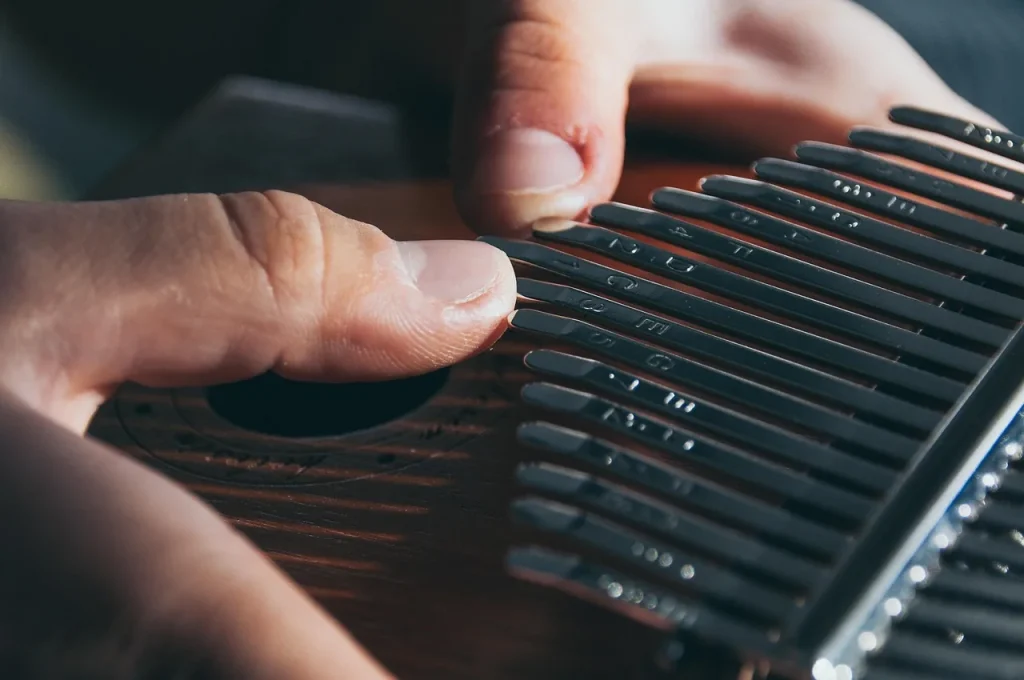
For more than 3,000 years, African thumb pianos have accompanied songs, stories, and ceremonies. Known by many names, this instrument carries a strong musical identity. Depending on the region, it may be called a mbira, likembé, or sanza.
In the modern world, the kalimba has found a new place. In 1954, ethnomusicologist Hugh Tracey helped bring it to an international audience. His version appeals to players with its clear notes, compact size, and ease of use.
The French company Instruments du Monde offers a 17-tine model, among others. This format suits beginners and curious musicians alike. It provides enough notes for varied melodies while remaining easy to learn.
This guide compares sound, tuning, materials, tine count, and intended uses. You will also find simple pointers to guide your choice, based on your hand size, budget, and where you play. The right model is, above all, the one that makes you want to play.
Understanding the thumb piano family
Before comparing models, it helps to place this instrument in the idiophone family. These instruments produce sound when their own bodies vibrate. They need neither strings nor a stretched membrane to produce a note.
An idiophone and lamellophone
The kalimba is also a lamellophone. Lamellophones use tines fixed at one end. Their free ends vibrate when plucked with the thumbs. Each tine produces a clear note.
Early tines were often carved from bamboo. Over time, makers developed more durable metal tines. This change brought stable intonation, a longer working life, and a consistent playing feel. The instrument remains straightforward for musical beginners.
The role of metal tines and the resonating body
The tines transfer their vibrations to the body. Its soundboard, made of wood or acrylic, amplifies the sound. The resonating body also shapes the tone, while openings increase projection. Depending on its shape, the instrument can sound gentle, bright, or deep.
These instruments appeal to players because they are compact. The thumbs control the tines precisely, without requiring years of technical training. This family is therefore accessible for solo playing, accompanying singing, or practicing at home.
Kalimba or sanza: What are the differences, and which should you choose?
The same thumb piano may have a different name depending on the region, language, or tradition. To avoid confusion, look at its construction, tuning, and use.
Names sometimes used interchangeably
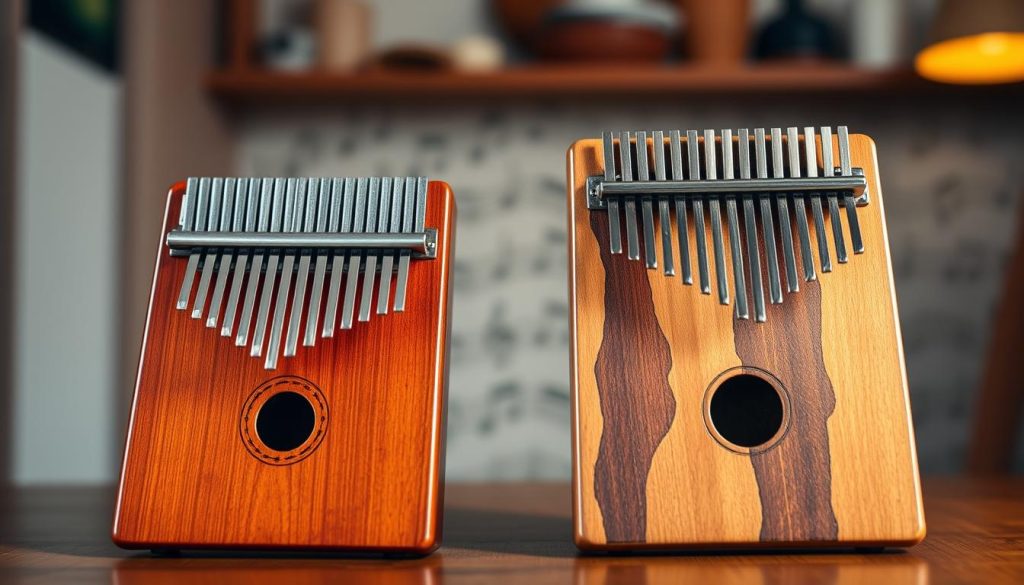
The sanza, also called senza, often refers to the mbira in several African regions. These instruments have more than a hundred names associated with different peoples. In France, kalimba has become the common term for a modern, standardized instrument that is easy to play. See this guide to thumb piano names as well.
How to tell them apart
The main differences concern the tines, body, available notes, tuning, and build quality. Hugh Tracey’s original model has 15 tines in one row. Common versions have 17, while some models have as many as 21.
Choosing for your musical practice
- Exploration or relaxation: a 17-tine kalimba is enough.
- Composition or accompaniment: choose a wider range of notes.
- Storytelling or stage performance: look for a sturdy body that can be amplified.
From African origins to modern models
This small piano has roots in a long African history. The earliest known traces appeared on the West African coast more than 3,000 years ago. Around 1,300 years later, the instrument appeared in Central Africa and then Southern Africa.
Its history runs through the Zambezi Valley. This broad region includes Zambia, Angola, Namibia, Botswana, Zimbabwe, and Mozambique. The story reveals the diversity of instruments associated with local music.
The long history of the sanza and mbira
The earliest tines were made from bamboo. This lightweight material made flexible tines suitable for precise playing. Over time, metal replaced bamboo. The newer tines lasted longer and held their tuning better.
Bamboo nevertheless remains part of the instrument’s history. Among the Shona people of Zimbabwe, the mbira accompanies ceremonies, celebrations, and certain spiritual practices. The modern kalimba draws on the same principle and makes it accessible worldwide.
- Bamboo: a natural feel, gentle sound, and traditional construction.
- Metal: stable tuning, greater durability, and easy maintenance.
Sanza, mbira, likembé, and kalimba: Understanding the names
The vocabulary of thumb pianos reflects a rich history. Each region has its own names for related instruments, although they do not always share the same design.
Regional variations on the same musical principle
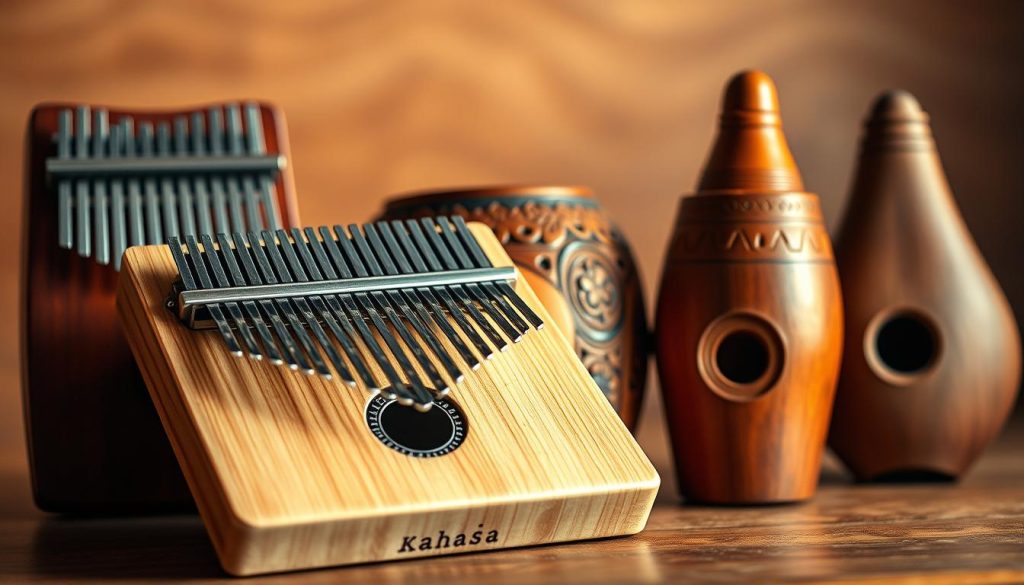
Likembé, mbila, huru, nhare, okeme, ubo, and gyilgo illustrate the variety of African names. They refer to traditions, forms, uses, and tones that sometimes differ.
The term sanza remains broad. It can describe several lamellophones, while the mbira often has a specific ritual role. For a closer look at these distinctions, read this comparison of thumb pianos.
The names change, but the musical gesture always relies on vibrating tines.
Hugh Tracey’s influence on the modern kalimba
In the 1930s, Hugh Tracey traveled through Africa, including what was then Rhodesia. In 1954, he created the modern kalimba for Western audiences. His model has 15 slender tines arranged in one row and tuned to G major.
Hugh Tracey thus played a central role in bringing it to an international audience. He believed this adaptation made African music more accessible. In 2001, Peter Hokema created the sansula, combining a kalimba with a frame drum.
| Name | Main feature | Context |
|---|---|---|
| Sanza | Broad term | African traditions |
| Mbira | Distinct cultural role | Southern Africa |
| Hugh Tracey kalimba | 15 tines, G major | Modern popularization |
| Sansula | Kalimba combined with a drum | Peter Hokema’s creation |
Design and tuning: The essential differences
The design quickly reveals what kind of instrument you are looking at. Hugh Tracey’s historic model has 15 tines in a single row. Modern models often have 17 tines, while some have 21. A greater number expands the kalimba’s melodic possibilities.
Tuning also varies by format. Hugh Tracey’s model is tuned to G major. Models with 17 keys are often tuned to C major. Versions with 21 keys are often tuned to F. Suitable tuning makes sheet music easier to read.
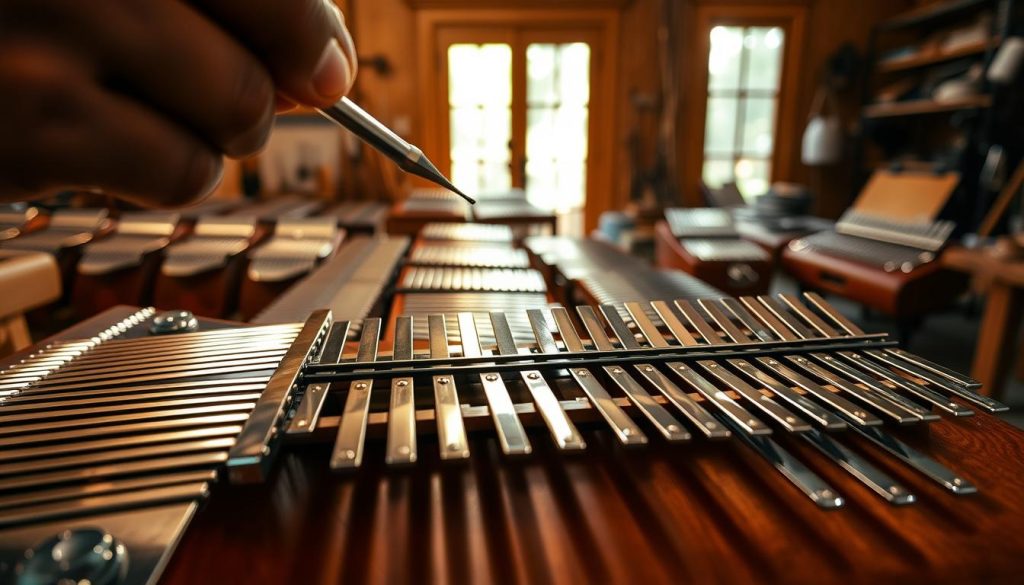
The length, width, and mounting of the metal tines affect pitch. A longer tine produces a lower note. Metal provides good stability. Careful adjustment improves tuning further. See this guide to tuning your instrument.
A hollow body increases resonance and projection. It gives the sound more presence. A flat board produces a quieter sound, ideal for gentle playing. The choice of body therefore depends on the number of notes, where you play, and the effects you want.
Sound, resonance, and playing effects
The characteristic sound depends on the tines, wood, openings, and shape of the body. Each instrument has its own character, suited to intimate playing or group music.
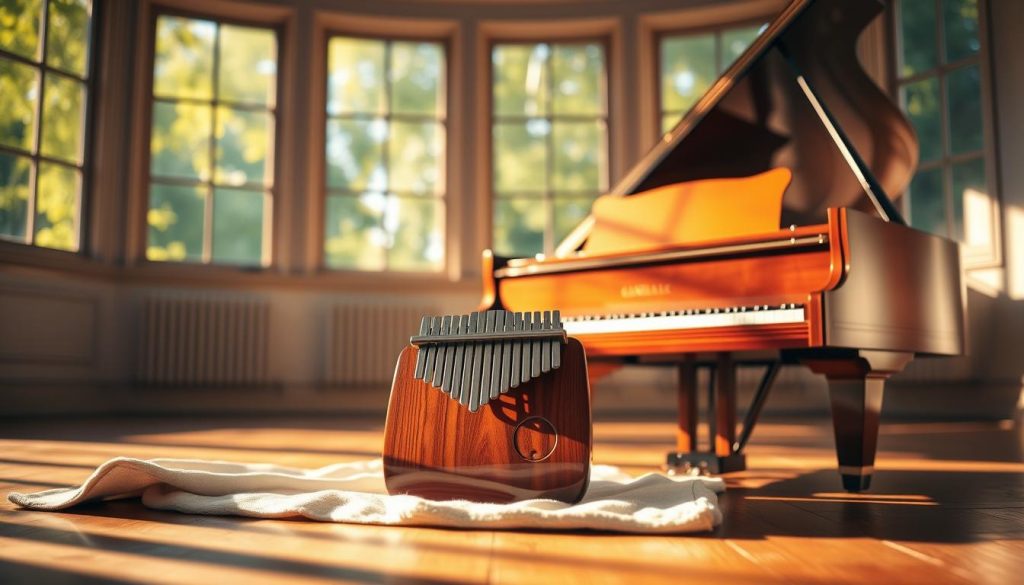
The traditional tone of the sanza
The sanza often sounds rawer, livelier, and warmer. Its tines may produce slight variations between notes. The modern kalimba, by comparison, aims for a clear, even sound with more controlled resonance.
Every vibration adds a nuance to the musical story.
Vibrato and wah-wah effects
Some mbiras carry metal caps. They create a delicate, almost shimmering buzz. Hugh Tracey’s model uses a front hole to alter airflow and enrich resonance. Two rear openings produce a wah-wah effect when the player covers and uncovers them with their hands.
- Gourd: full resonance, organic tone, and long sustain.
- Wood: steady resonance, clear tone, and balanced volume.
- Hand technique: expressive effects and precise thumb control.
| Construction | Resonance | Tone | Volume |
|---|---|---|---|
| Gourd | Full | Warm | Natural |
| Wood | Controlled | Clear | Even |
Wood, acrylic, and metal: Which material should you choose?
The material determines an instrument’s weight, feel, and sound. For a first kalimba, wood is a reliable choice. However, build quality matters more than appearance.
Mahogany and other woods
Among woods, mahogany offers an excellent balance. This wood is lightweight, affordable, and comfortable for beginners. Its gentle sound suits quiet sessions. Another mahogany model can provide a warm response without making the body heavy. Mahogany therefore suits hands that are still getting used to the instrument.
Koa lends a warm tone. Black walnut offers a rich sound. Maple produces greater clarity. These differences show how wood influences each note, while a carefully applied wood finish protects the surface.
Acrylic: Design, weight, and durability
Transparent acrylic appeals with its modern style. Acrylic better resists moisture, temperature changes, and minor knocks. Its durability makes it suitable for travel. However, acrylic is often heavier, costs more, and may tire the hands during a long session. Before buying, check the quality of the tines, metal, and finish. A well-assembled acrylic model offers better durability than one with a fragile finish. This fifth mention of acrylic underscores the importance of that consideration.
Choosing the right number of tines for your level
The number of keys affects handling, range, and progress. For this instrument, the right format depends on your level, intended repertoire, and hand size.
A range suited to beginners and advanced musicians
Formats with 10 to 15 keys suit children and beginners. They reduce the number of notes to remember. This layout supports relaxed learning and comfortable thumb movement.
The 17-key kalimba offers the best balance. It has enough notes for continued progress. There is also plenty of sheet music and many tutorials for it.
Formats with 21 keys or more suit advanced musicians. Their wider range supports complex arrangements. Teaching resources, however, are less plentiful.
- Beginners: 10 to 15 keys to learn without overload.
- Progressing players: 17 keys, varied sheet music, and common tuning.
- Advanced musicians: 21 keys for a broader repertoire.
Five minutes of playing each day is enough to strengthen precision, coordination, and confidence. Your final choice should account for hand size, the number of keys you want, and how often you will play.
| Number of keys | Recommended players | Resources | Main advantage |
|---|---|---|---|
| 10 to 15 | Children, beginners | Simple sheet music | Easy to handle |
| 17 | All levels | Sheet music, tutorials | Balanced progression |
| 21 or more | Advanced musicians | Limited resources | Extended range |
Which instrument suits each musical use?
The right format depends on the setting, your level, and the comfort you want. A thumb piano for home use does not meet exactly the same needs as a stage instrument. Here are simple pointers for choosing according to your intended use.
Learning, playing with a child, or relaxing
For beginners, a kalimba with 10 to 15 tines is easy to handle. A mahogany body produces a warm tone at a moderate volume. This format also suits early music activities, relaxation, and music therapy.
A simple instrument often encourages daily practice.
Traveling, storytelling, and playing outdoors
A flat model is lightweight, compact, and easy to pack in a case. It suits travel, storytelling, and outdoor music. For greater resonance, a hollow-bodied model can produce expressive wah-wah effects.
Recording or performing with amplification
For a musician, an electro-acoustic kalimba with a piezoelectric pickup or jack output is easier to amplify. A second kalimba with stable tuning can serve in the studio. Before playing, also check the accessories, body, wood, and how comfortable the instrument feels under your thumbs.
Playing comfort, tine spacing, and ergonomics
Handling an instrument quickly reveals its ergonomic quality. An adult with large hands may appreciate more space between the tines. For a child with short fingers, a closer layout makes the notes easier to reach.
A hollow model often leaves more room around the thumbs. Its body can also provide good comfort during a long session. A well-polished wooden body reduces rough spots and fatigue for small hands.
The length of the tines affects the register. Longer tines give lower notes. Shorter ones produce higher notes. This arrangement also influences the instrument’s response to playing and the natural position of the fingers.
- Reach: your thumbs should reach every note without strain, whether the model has 17 or 21 keys.
- Handling: test the weight, edges, and balance before buying.
- Adjustment: check how readily the keys move to protect your comfort.
Careful listening helps you identify the format that suits you. To explore the subject further, see these kalimba resources.
Quality, budget, and accessories for a successful purchase
Price gives you a starting point, but quality matters more for enjoyable progress. A budget of €30 to €50 can often get you a well-assembled wooden instrument with good durability. This range is suitable for a first stable kalimba.
Identifying a reliable, well-tuned instrument
Before buying, inspect the alignment of the tines, screw fittings, body, and volume. Test the tuning across several notes. A consistent response indicates better quality. Below €20, tuning is often unstable, which can discourage a beginner. Gecko, Lingting, and Hluru provide points of comparison. A suitable number of tines also improves thumb comfort.
Useful accessories for getting started
A bundle can make the choice easier. It may include a tuning hammer, case, stickers, thumb guards, and a sheet music booklet. These accessories reduce the need for separate purchases. Still, check the booklet’s quality, the case’s strength, and the kalimba’s finish. A complete set makes the first playing sessions easier.
| Budget | Player | Equipment | Advice |
|---|---|---|---|
| Under €20 | Cautious first purchase | Few accessories | Check the tuning |
| €30 to €50 | Beginner | Wood, possibly a case | Best balance |
| Over €50 | Regular player | More refined finish | Compare instruments |
Learning, care, and musical progress
A short routine helps you improve gradually, session by session. To begin with this instrument, a simple tablature is enough. It may show the number, name, or drawing of each tine. Beginners can then follow the notes without immediately learning to read standard notation.
Sheet music, tutorials, and everyday tuning
On a kalimba tuned to C, repeat the sequence 1 – 2 – 3 – 2 – 1. This exercise develops consistency, listening, and thumb coordination. Sheet music should match the number of tines on the model.
YouTube offers many tutorials for learning to play this thumb piano. Check the note names before each session as well. Simple goals help musicians build confidence. Find more information on traditional African instruments.
- Check the tuning every two months with a suitable hammer.
- Adjust each tine gently to preserve sound quality.
- Wipe the piano with a dry cloth, then store it away from radiators.
A case protects the wood, metal, and accessories. These simple steps improve the kalimba’s durability. Progressive sheet music, clear tutorials, and regular tuning support continued progress.
Conclusion
In short, the modern kalimba uses an old principle: plucked tines produce a clear melody. The sanza retains a strong connection to African traditions. The differences mainly concern tuning, the body, materials, and uses.
For beginners, a well-tuned 17-key model provides easy access to sheet music, tutorials, and regular practice. A mahogany instrument offers a good balance of comfort, sound quality, weight, and price.
A hollow body favors projection, expressive effects, and stage playing. A flat format is better suited to travel, close-up recording, and quiet sessions. To choose, consider the music you want to make, thumb comfort, your skill level, and how you play. See also this guide to the two thumb pianos.