
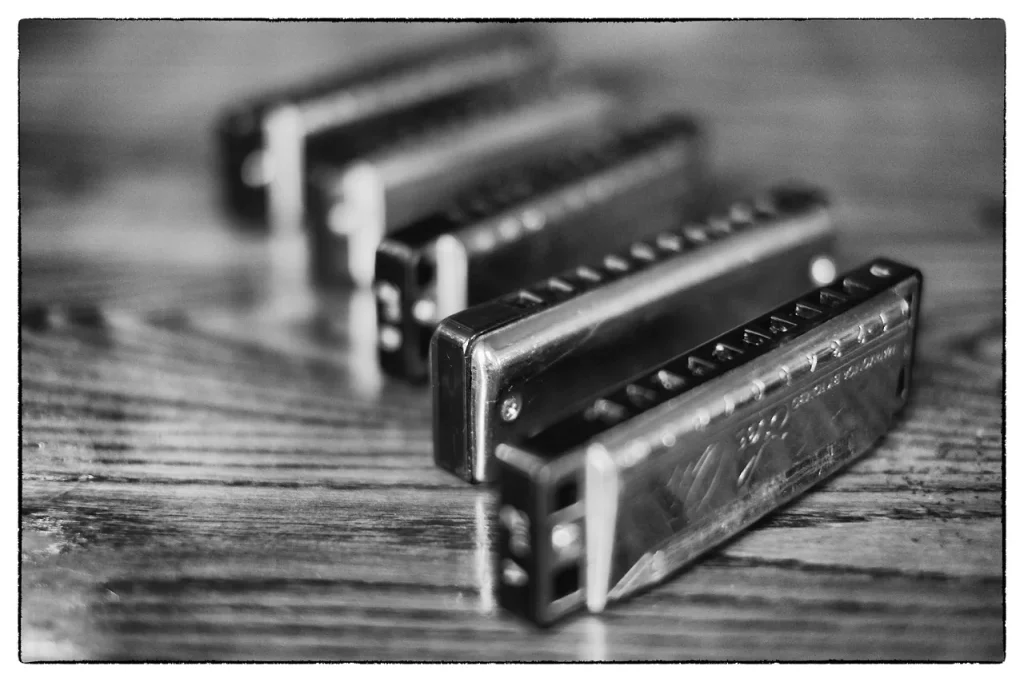
This guide takes you through each step of playing, note by note, the diatonic harmonica line that opens the Beatles’ first single. Paul McCartney worked out the main structure at age 16, and the riff left its mark on early 1960s British pop.
You will learn to read harmonica tabs, control your breath (drawing or blowing), keep time, and play your first bends. The method builds gradually: read the riff, focus on the difficult draw notes (-3 and -2’), then put the phrases together.
Who it’s for: motivated beginners and intermediate players who want to improve their articulation and rhythmic consistency. What you’ll achieve: play the opening riffs and variations through the final cadence with a clean sound.
To place the song in context, see this historical ranking of Beatles songs. Practice with a metronome and relax your jaw to make steady progress.
Background, equipment, and basics for the Love Me Do intro
To get the authentic sound, choose your instrument and key, then make a few simple adjustments.
Historical background: this melody opens the Beatles’ first single. Paul McCartney worked out its main structure at 16, creating a simple but expressive riff.
Recommended diatonic harmonica, key, and basic setup
Use a 10-hole diatonic harmonica, the type of instrument used for this line. Choose a standard key (often C) to make learning easier and bends more accessible.
Check the instrument’s condition: reed response, airtightness, and the cleanliness of its plates. Start with a neutral setup so you can work on breath control before making any personal adjustments.
Use a pucker embouchure, playing one hole at a time to isolate each note. Later, you can try tongue blocking to vary your tone.
Tab basics: numbers indicate holes; a “-” means draw in; without it, blow out. Double and single quotation marks indicate bends.
“Listen to the original recording to catch its rhythmic placement and subtle swing.”
- Practice with a metronome: start slowly and increase the speed gradually.
- Control your breathing and relax your jaw to produce clean draw notes.
Love Me Do on harmonica: play the iconic intro step by step
Start with your breathing. Matching each inhale and exhale to the recording’s pulse helps you capture its phrasing and swing. Breathe slowly and keep your jaw relaxed.
Breath placement and rhythm inspired by the Beatles’ original recording
Tip: inhale on notes marked “-” and exhale on the others. Keep the airflow steady for clean note attacks.
- Practice slowly with a metronome, then raise the tempo.
- Keep the attacks on the repeated 3s short and give blown notes a rounder sound.
Reading the opening line: -5 5 -4 3 3 3 3
Start -5 gently, release into 5, and steady the -4. Keep the four “3” notes light and even to form the foundation of the riff.
Connect the main riff and master the essential bends
Group the three -5 notes, then the three 5 notes, to memorize “-5 -5 -5 5 5 5 -4 3 3 3 3.” Next, practice the bends “-3\” 3 -2’” slowly, followed by the transitions “-2 -2\” 2 -1,” coordinating your breath and release.
Put the phrases together and loop the riff
Play the variation “-5 5 -4 3 3 3 4 -3,” then loop into “3 3 3 3 3 3 4 -3.” Repeat these phrases in cycles until the cadence feels smooth and natural.

Playing tips, common mistakes, and finding the groove
Build simple habits that strengthen the groove and reduce common mistakes. Breathe deeply from your abdomen and keep the airflow continuous to stabilize draw notes and bends.
Breathing and articulation: lightly say “da/ta” to make each attack clear without making the tone harsh. Use a metronome and mentally subdivide the beats to keep a steady tempo through groups of three and four repeated notes.
Clean up -3 and -2’: start above the target pitch and bend slowly down until the note is in tune. Keep your lips relaxed and your tongue mobile to control -3″ and -2’ without clenching your jaw.
For the transition “-2 -2\” 2 -1,” prepare the bend gently with your tongue and maintain steady airflow. Then release into 2 and -1 for a clean ending. Isolate the loop “-3\” 3 -2’” and repeat it 5 to 10 times at a slow tempo before returning it to the full phrase.
“Listen to the Beatles’ recording to refine the nuances: light accents, softer notes in between, and a settled ending.”
Conclusion
Here is what matters most for mastering the opening. Practice the main sequences (-5 5 -4 3 3 3 3; -5 -5 -5 5 5 5 -4 3 3 3 3; -5 5 -4 3 3 3 4 -3; 3 3 3 3 3 3 4 -3) and the bent passages (-3″ 3 -2′; -2 -2″ 2 -1).
Key points: breathe deeply, articulate lightly, and use a metronome to keep a steady rhythm. The essential bends form the technical foundation. Practice slowly, then raise the tempo in stages to keep the notes in tune and the transitions smooth.
Listen to the original recording again to refine your phrasing. Then extend the exercise to the rest of the song and try other iconic intros to expand your musical vocabulary.