

This tutorial offers a roadmap for understanding a great soloist’s playing and bringing his techniques into your daily practice.
A brief history: the chromatic harmonica gained popularity in soul music as early as 1963 with “Fingertips (Part 2),” recorded when Stevie Wonder was 13, and demand soared, according to Billboard.
We explain how the chromatic harmonica’s slide gives you access to every note of the scale and makes the key changes common in jazz easier to play. The guide also compares chromatic and diatonic harmonicas.
The program covers historical context, key techniques (the slide and saxophone-like phrasing), choosing keys when playing with horns (B-flat and E-flat), exercises inspired by the song, and equipment and sound.
We also look at the sound chain: instrument model, embouchure, hand position and recording setup (reverb and slight saturation) to help you approach his distinctive sound.
To begin, play simple patterns, master the transition between blown and drawn notes, then add syncopation and rhythmic variations.
Looking for an instrument to get started? Read our guide to choosing a good beginner model: best beginner harmonica.
The central question: how can you develop an expressive solo style in the right key, with a convincing sound, while keeping the music flowing?
From soul to jazz: why Stevie Wonder redefined the chromatic harmonica
A televised performance in 1963 showed that the chromatic harmonica could hold its own against the saxophone as a solo instrument. The solo in “Fingertips (Part 2)” puts the instrument in the lead and opens new possibilities for young musicians.
In 1964, Billboard reported rising harmonica sales, driven by the Beatles, the Rolling Stones and Stevie Wonder. Hohner benefited from the surge; chromatic harmonicas found their way into urban recording studios.
Chromatic or diatonic
The chromatic harmonica gives you access to every note of the scale through a slide. This makes key changes and jazz-like phrasing easier.
The diatonic harmonica is designed for one key and lends itself to traditional blues. On a chromatic harmonica, for example, you can move a pattern from C to D-flat instantly without changing position.
| Criterion | Chromatic | Diatonic |
|---|---|---|
| Access to semitones | Yes, through the slide | Limited; note bends are needed |
| Musical use | Jazz, soul, melodic solos | Blues, folk, riffs |
| Common keys in ensembles | E-flat and B-flat are easy to play | Often C or A, depending on the song |
Goal of the tutorial: to help you develop an expressive solo style by mastering key and phrasing for ensemble playing.
Stevie Wonder on Harmonica: Techniques to Learn
Mastering the slide makes a big difference. Alternate between natural notes and semitones with the slide to create expressive chromatic passages. This lets you handle rapid harmonic changes, a useful skill in jazz and soul.
Articulation and saxophone-like phrasing
Practice note attacks (ta/da), legato and detached playing. Add syncopation and anticipations. Think of your breath as a continuous stream of air to create singing phrases.
Managing keys in practice
Focus on B-flat and E-flat for ensemble playing. These keys make it easier to play with horns; avoid E when you are starting out.
Holes, breath and range
On a 12- to 16-hole chromatic harmonica, coordinate blown and drawn notes across three octaves. Work on pitch accuracy and smooth transitions without unwanted noise.
Exercises inspired by Fingertips
- 10 minutes of chromatic scales using the slide.
- 10 minutes of syncopated phrases with a metronome.
- 10 minutes of short call-and-response patterns that move into a flat key.
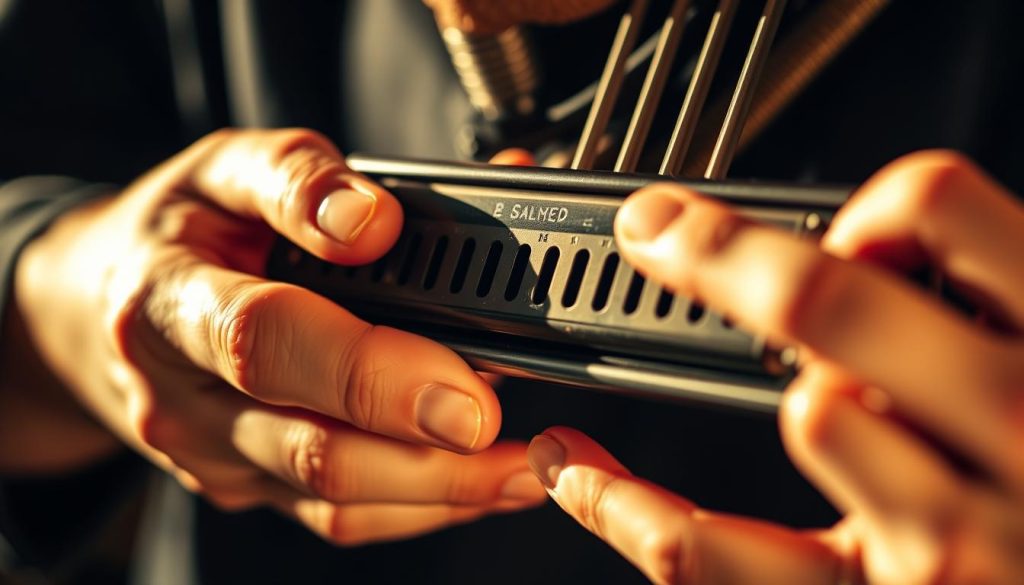
Equipment, key and tone: getting a convincing Stevie-style sound
The final tone depends first on the instrument, then on your embouchure and recording chain.
Which model should you choose? Consider a chromatic harmonica such as the Hohner Super 64, whose response and projection resemble those heard on classic recordings. The Suzuki Chromatix is another good, more accessible option.
Materials and size
Harmonicas come in wood, metal or plastic (including wood-resin composites). Wood can feel warm to play, but requires more care.
Metal models are bright and sturdy. Plastic models offer good stability at a manageable cost.
Choosing a key
Focus on E-flat and B-flat when playing with horns. Keep a model in C or A minor for ear training.
Embouchure, sound and recording
Form a consistent mouth cavity and vary how widely you open your hands to shape the tone. For recording, start with a clean sound, add short to medium reverb and avoid excessive compression.
Care and accessories
Remove condensation after every session, leave the instrument open to dry and use a maintenance kit to help prevent reed oxidation. Control your breath pressure to protect the holes and reeds.
- Harmonica holder for playing guitar and harmonica
- Dedicated microphones for the sound you want
- Cases for carrying several harmonicas to rehearsals
Conclusion
The key to this style is combining breath control, accurate pitch and a suitable model. Master the slide to play the chromatic scale, work on saxophone-like phrasing and focus on B-flat and E-flat for ensemble playing.
Plan three sessions a week: 10 minutes of patterns inspired by Fingertips, 10 minutes of rhythmic variations and 10 minutes of improvisation over a backing track in E-flat. Choose a reliable model (Hohner Super 64 or Suzuki Chromatix) and care for it regularly by removing condensation and cleaning it.
Record yourself, compare the sound with and without reverb, and aim to develop a personal tone shaped by Stevie Wonder’s legacy that serves the music and the ensemble.