

Two names often come up for a small thumb piano: kalimba and mbira. Yet these names can refer to different histories, shapes and uses. That raises a simple but essential question before choosing a model.
These instruments belong to the lamellophone family: idiophones that produce sound when metal or plant tines are plucked with the thumbs. The body, soundboard and resonator amplify each vibration. Their design strongly influences a tone that can be soft, clear or highly resonant.
The mbira, from southern Africa, has great cultural importance. The earliest evidence of African lamellophones dates back more than 3,000 years. The modern form of the kalimba later spread around the world after Hugh Tracey popularized the term in 1954.
This guide explains their origins, materials, tuning, number of tines and playing styles. It also looks at their place in music today and helps you understand each instrument.
Understanding the African lamellophone family
A simple movement creates the vibration: a thumb releases a tine fixed to a support. This principle places these instruments in the lamellophone family, a group of idiophones played with the thumbs. Each note rings out quickly with a soft, precise tone.
How tines are plucked with the thumbs
The musician holds the body with both hands, leaving the thumbs free to pluck the tines. The length of each tine determines its pitch, while its tension affects how long it rings. This makes steady playing possible even for a beginner.
“Sound begins with a vibration, then travels through the support.”
To learn more about the lamellophone family, follow the path the sound takes.
The role of wood and the resonator
A tine transfers its vibration to the soundboard and then to the body. Wood often gives a warm sound. A flat board produces moderate volume. A hollow box increases volume, while a calabash naturally strengthens the low notes.
- Materials change the tone.
- The shape of the support affects resonance.
- How the tines are fixed affects the clarity of the sound.
| Support | Sound | Common use |
|---|---|---|
| Flat board | Light sound | Intimate playing |
| Hollow box | Strong volume | Accompaniment |
| Calabash | Stronger bass | African tradition |
Kalimba or mbira: what are the differences between these instruments?
African musical vocabulary covers several closely related forms. The term kalimba often refers to a modern model sold in France. Mbira more often refers to a Shona tradition from Zimbabwe with deep cultural significance.
In 1954, Hugh Tracey popularized the first term to help bring the instrument to a wider audience. Sanza, karimba, likembe and mbila also belong to the broad lamellophone family. They may look similar, but each has its own history.
Similar names for different instruments
The karimba is closely related to the nyunga nyunga, which often has fifteen tines. A common modern version has seventeen tines tuned to C major. This layout makes first melodies accessible to beginners.
To distinguish the kalimba from the mbira, look beyond their names and examine how they are made.
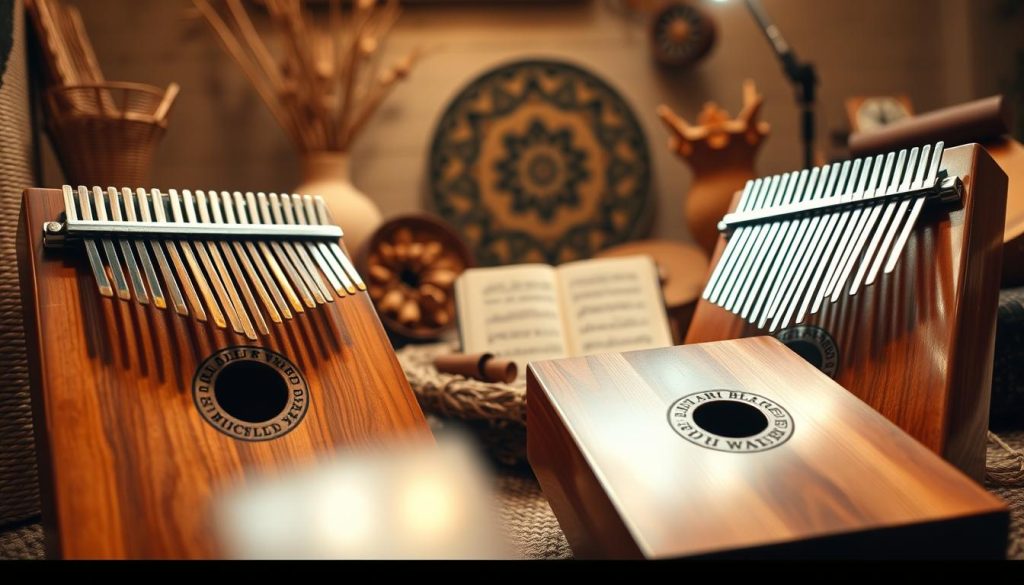
Key features that distinguish them
- The number and arrangement of the tines.
- The shape and materials of the body.
- The tuning, origin and ways musicians use them.
| Feature | Modern model | Shona tradition |
|---|---|---|
| Use | Learning and creating music | Ceremonies and passing on traditions |
| Notes | Diatonic scale | Local tuning system |
| Playing style | Two thumbs | Cyclical patterns |
African origins and historical development
Long before reaching the modern stage, this instrument developed from locally available resources. Its African origins go back more than 3,000 years, according to the earliest traces of bamboo tines found on the west coast.
From early bamboo tines to metal tines
Evidence also appears in central and southern Africa around 700 BCE. The transition to metal about 1,300 years ago improved the stability of notes and the precision of tuning.
Materials also play a major role. Calabashes, wood and other resonators strengthen low notes and enrich the harmonics. This development gave lamellophones a wide variety of tones.
Lamellophones in the Zambezi Valley
The Zambezi Valley extends through areas of Zambia, Zimbabwe, Mozambique, Angola, Namibia and Botswana. In this region, music accompanies social life and rituals. In the 20th century, Hugh Tracey brought a standardized version to audiences worldwide.
| Period | Development | Effect on sound |
|---|---|---|
| More than 3,000 years ago | Bamboo | Natural tone |
| Around 700 BCE | Regional spread | Ritual uses |
| 1,300 years ago | Metal | More stable notes |
| 20th century | Worldwide spread | Standardized playing |
The traditional mbira and its role in Shona ceremonies
In Zimbabwe, Shona music gives this instrument a role far beyond producing sound. Its history has been passed down through families and communities for generations. The mbira dzavadzimu gives voice to a ritual connection with ancestors.
The mbira dzavadzimu and communication with ancestors
It generally has two rows of tines, usually 22 or 23 in total. Their tuning creates cycles of notes suited to ceremonies. Thumb playing supports singing, handclapping and collective memory.
Shona ceremonies include requests for rain, weddings and exchanges with the spirit world. Music becomes a shared language carried by the tines and the voice.
The calabash, metal bottle caps and polyrhythms
A wooden board sits inside a calabash called a deze. This resonator amplifies the soundboard’s vibrations. Metal bottle caps add an intentional buzz and rattle that enrich the tone.
- Kushaura starts the main pattern.
- Kutsinhira answers it with a complementary rhythm.
- Singing and handclapping strengthen the polyrhythm.

The modern kalimba popularized by Hugh Tracey
In 1954, Hugh Tracey adapted an African tradition to create a thumb piano for a broad audience. He adapted the mbira into a diatonic instrument that was easy to learn. His model had fifteen tines tuned to G major.
This historical background explains the kalimba’s place in learning today. Hugh Tracey kept the traditional principle, then adapted it to the expectations of Western musicians.
Standardizing the diatonic model
The tines are held beneath a crossbar and rest on a bridge. Adjusting them determines the pitch of the notes. Good tuning makes playing easier and each note clearer. Metal also provides a consistent response.
One front hole and two rear holes enrich the body’s resonance. The fingers produce vibrato and then a wah-wah effect as they open or close the holes. The wooden soundboard adds warmth to the tone.
Models with fifteen, seventeen or twenty-one tines
Fifteen-tine models remain compact. Seventeen-tine versions offer more notes, while twenty-one-tine versions extend the range. Mahogany produces a warm sound; acrylic adds clarity and projection. Electroacoustic models also meet the needs of performers.
- 15 tines: discovery and portability.
- 17 tines: versatile learning.
- 21 tines: wider melodic possibilities.
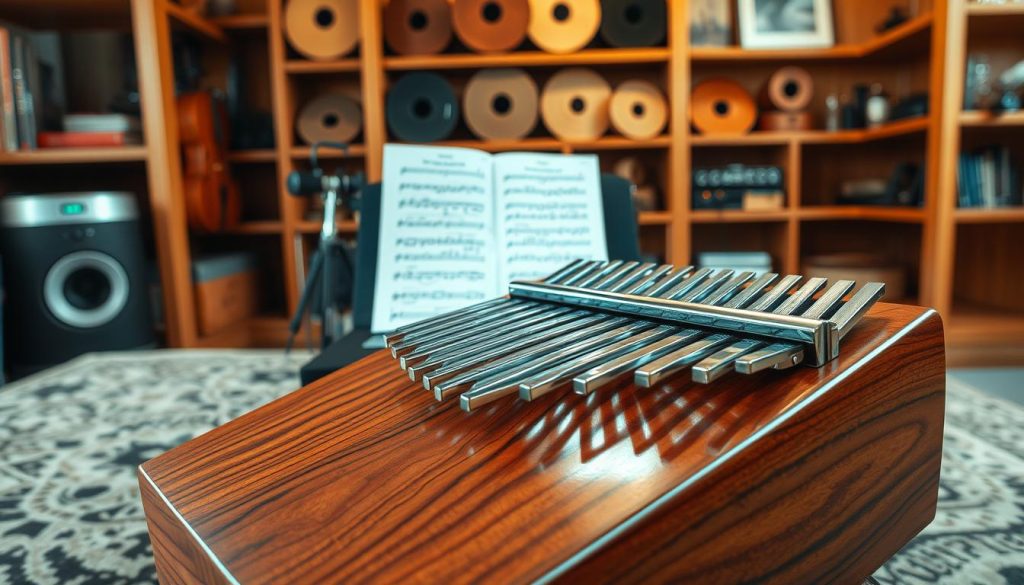
Sanza, karimba, nyunga nyunga and Sansula: understanding the names
African names describe a broad family of instruments with tines. They vary by region, language, body and use. Sanza, karimba and kalimba sometimes refer to similar forms without necessarily sharing the same tuning.
Regional names for instruments with tines
More than 100 regional variants have been recorded. Likembe, mbila, nhare, matepe and njari reflect this variety. The number and arrangement of tines, together with the instrument’s stated origin, provide useful clues for identifying each model.
The nyunga nyunga generally has 15 tines. Its design makes learning and playing melodic patterns easier. Its construction and educational role distinguish it from the mbira dzavadzimu, which is associated with Shona ceremonies.
- Compare the number of tines.
- Examine the body and tuning method.
- Check the name used by the maker.
The Sansula and its frame-drum membrane
Created by Peter Hokema in 2001, the Sansula mounts a kalimba on the membrane of a frame drum. This flexible structure gives it broad resonance and a distinctive sustain. This modern instrument is appreciated around the world for its gentle sound.
A name alone is therefore not enough: construction, tine count and musical purpose remain essential.
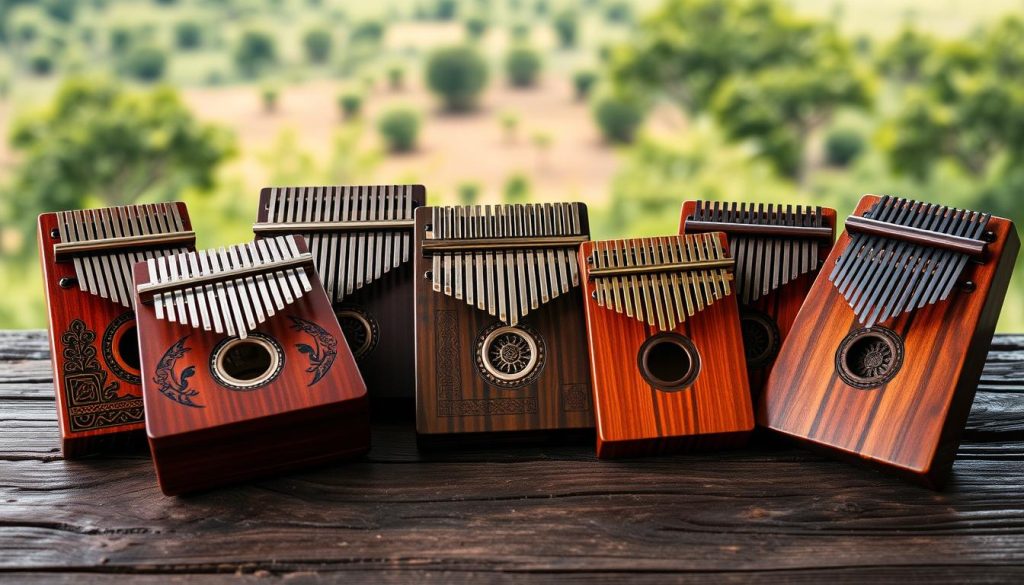
Construction, materials and their effect on resonance
The chosen material changes tone, volume and lifespan. For this instrument, the body’s shape matters as much as the quality of its parts. A few points about the materials used will help you compare models.
Wood, acrylic or calabash for the instrument’s body
Wood gives a soft, natural response. Mahogany balances low and high notes with a warm tone. Acrylic provides clear projection, which is useful on stage. A calabash also strengthens the bass through its hollow shape.
For intimate playing, wood remains pleasant to hold. Acrylic models withstand knocks well and offer a clear sound. A calabash body appeals through its traditional character and strong resonance.
Steel, metal or bamboo for the tines
Steel tines produce a bright attack and hold their tuning better. Metal produces precise notes. The earliest tines, often made of bamboo, had a softer sound.
“The material gives the musician’s gesture a voice.”
- The soundboard transfers vibrations to the resonator.
- The bridge stabilizes the tines.
- The crossbar helps notes sustain.
Before buying, compare sound quality, weight and durability. Three well-adjusted tines matter more than an expensive finish. Materials also influence a model’s overall resonance.
Sounds, notes, tuning and playing techniques
Tone depends on the number and arrangement of notes and on the support. A well-tuned instrument makes learning smoother. When reading the kalimba guide, pay attention to how the tines respond.
Traditional, diatonic and chromatic scales
Traditional tunings are not always diatonic. Modern models offer diatonic, pentatonic or chromatic scales. A simple layout makes melodies easier to play, while a wider range helps musicians form chords.
- Diatonic scale: practical for beginners.
- Pentatonic scale: melodies that are easy to improvise.
- Chromatic scale: more notes and greater freedom.
Vibrato, wah-wah and control of the body
Vibrato arises when the hands change the body’s resonance. To create a wah-wah effect, cover and uncover the sound holes. Keep your movements light to preserve clarity.
Thumb playing, melodic patterns and rhythmic accompaniment
The thumbs alternate between bass notes and melodies. Interlocking patterns recall Shona polyrhythms, particularly kushaura and kutsinhira. The thumb piano thus becomes a complete instrument.
- Play arpeggios for 5 minutes.
- Practice vibrato and the wah-wah effect for 5 minutes.
Current uses in music, meditation and sound creation
Today, the kalimba appeals through its simplicity and calming sound. Its intuitive playing style suits learning, daily practice and first compositions. This small piano also has a place in wellness activities.
Learning, relaxation and music therapy
In music therapy, its gentle harmonics may help reduce stress. They can accompany breathing, relaxation and preparation for sleep without requiring advanced technique. This approach complements care rather than replacing it.
- Gradual learning through intuitive playing.
- Relaxation supported by warm resonance.
- Creation of simple musical loops.
Stage, pop, experimental music and home studio
Pop and experimental musicians choose models fitted with a microphone, preamp, direct output or piezoelectric pickup. The kalimba thus becomes a versatile stage instrument.
In a home studio, electroacoustic models make recording easier. A wooden body retains a soft tone, while some materials produce a brighter sound. To explore this subject further, see our complete kalimba guide.
How do you choose between a kalimba and a mbira?
The choice mainly depends on your experience, intended repertoire and preferred feel. A simple model helps you progress, while traditional craftsmanship suits musicians drawn to Shona heritage. This guide to choosing explains the essentials.
A model for beginners and daily practice
For learning, a 17-tine kalimba in C major is a good starting point. Its layout makes first melodies easier to play with the thumbs. Light and comfortable to hold in both hands, it suits regular practice.
Anyone drawn to traditional repertoire will benefit from seeking an authentic mbira. Its tuning, cultural context and cyclical playing style call for a more focused approach.
What to check before buying
- Check the key, number of tines and overall appearance of the model.
- Examine the body, materials, stated origin and tuning stability.
- Make sure the tines are aligned, with no sharp edges or unwanted buzzing.
- Look for a case, tuning hammer and accessible tuning adjustments.
Solid construction helps preserve tuning during travel and changes in humidity. The best models feel pleasant to play from the first notes.
Conclusion
Beyond commercial names, the kalimba and mbira belong to the same lamellophone family while retaining distinct identities. The mbira carries the Shona history of Zimbabwe: ceremonies, local tunings and a calabash resonator are central to its identity.
Popularized by Hugh Tracey in 1954, the modern version is designed for straightforward playing. Its diatonic layout supports learning, with clear notes, a wooden soundboard and a body made for pleasing resonance.
When choosing among instruments with tines, consider origin, tine count, tuning and wood. Musicians can then match their choice to their repertoire, experience and musical tastes. They can choose a true musical instrument for its history as well as its sound.