
Need a clear plan to get started? Pick up a 10-hole diatonic harmonica in Bb and follow a five-video Starter Pack. In less than an hour, you can play your first tune and build confidence.
The method combines short lessons, a paced progression through the basics, effects and improvisation, and 12 free lessons. Monthly group workshops with recordings provide regular personal support.
Learning designed for beginners: Richter tuning, a gradual introduction to reading rhythm, and “navigation weeks” featuring more than seven practice pieces. Artists such as Jean-Jacques Milteau and Charlie McCoy are cited as teaching references.
Unlimited access on iOS and Android, sheet music, tabs and interactive tools. One example offer is six months plus workshops for €199 before tax, with a 30-day guarantee. Everything is designed to make your introduction to music simple, quick and reassuring.
Learn to play harmonica online, simply and quickly
The method focuses on playing right away. A five-video Starter Pack covers how to hold the harmonica, embouchure, breathing, a train effect and shuffle rhythm. These short lessons help you produce clear notes quickly.
No music-reading experience is required. The videos show each movement through visual demonstrations and step-by-step instructions.
Quick results: you can learn to play your first tune in less than an hour. The progression draws on more than 20 years of teaching and experience with hundreds of students.
Recommended practice: 10 to 20 minutes a day. Over time, this routine helps you make steady progress and stay motivated.
- Goal: play well, quickly, with a step-by-step path.
- Simplicity: focused lessons and videos available on every device.
- Benefit: play a recognizable melody and rediscover the pleasure of music.
Online harmonica lessons: where to start
The best start combines a suitable instrument, a simple technique and focused exercises.
Choose your instrument
Recommendation: a 10-hole diatonic harmonica in Bb. This model works well with the accompaniments and the Starter Pack.
| Model | Feature | Best for |
|---|---|---|
| Model A | Wood / warm sound | Beginners seeking a traditional tone |
| Model B | Plastic / easy care | Beginners who want easy maintenance on a limited budget |
| Model C | Adjustable / comfortable mouthpiece | Beginners who want to progress quickly |

Basic technique
Use an open, steady embouchure. Avoid tight puckering and U-block embouchures that muffle the sound.
Breathing through the instrument is essential. Control your airflow to maintain a consistent tone and avoid fatigue.
First exercises and free trial
Start by playing clean single notes, then move slowly between them. Find the rhythm with short phrases.
A pack of 12 free lessons lets you assess the teaching approach without risk. It covers the basics, effects such as dip bends, glissando and tongue slaps, and a gradual introduction to improvisation.
- A digital guide comparing six beginner models.
- Short exercises to establish breathing and phrasing.
- A step-by-step path to learning to play harmonica.
A step-by-step method: play your first tune in less than an hour
A clear, well-paced progression guides you to your first tune in less than an hour. The Starter Pack brings together five structured videos so you can start playing right away.
The five-video “Starter Pack”
The videos cover equipment and posture, an effective embouchure, controlled breathing, the train effect and a shuffle rhythm, followed by a guided tune for beginners.
Practice plan: 10 to 20 minutes a day with guided exercises
Practice for 10 to 20 minutes each day to build a lasting habit. Each session has a specific goal: a clean note, a steady rhythm or a short melody exercise.
Three learning stages
The progression avoids sudden jumps in difficulty. The stages are complete beginner (lessons 1 to 4), techniques and effects (lessons 5 to 8), then improvisation (lessons 9 to 12).
- Exercise sequence: simple movements, followed by combining sound, rhythm and expression.
- Milestones: clean notes, steady rhythm, first effects and short improvised phrases.
- Recordings: revisit key passages at your own pace.
Tip: playing a tune in less than an hour can strengthen motivation and help establish a routine.
For more guidance, explore the full learning path and practical resources: starter pack and progression plan.
Complete module program: techniques, rhythm and tunes
Get immediate access to six modules designed to connect knowledge of the instrument with music-making. Each unit covers one concept so you can make tangible progress by the end of the lesson.
From anatomy to Richter tuning
The first module introduces the instrument’s anatomy, note names and Richter tuning. Understanding the note layout makes it easier to move around the harmonica and accompany other transposing instruments.
Learn to read rhythm gradually
The progression covers note values from whole notes to sixteenth notes, duple and triple rhythms, rests and ties. These concepts develop the rhythmic precision needed for expressive playing.
Techniques and effects
The program covers chugging, six train effects, articulation and phrasing. Short exercises let you apply each technique immediately.
Navigation weeks and repertoire
Each module contains more than seven practice pieces. End-of-unit examples include Brassens’s “La prière,” “Scarborough Fair” and original compositions such as “La croisière démarre.”
Two monthly learning packs add demonstrations, backing tracks, sheet music and tabs for a complete guided experience.
Personal support: group workshops and a motivating community
A guided community helps ease uncertainty and gives each student clear goals. The “Cercle des Marins d’Eau Douce” brings together beginners guided by a professional musician. This format meets the need for personal feedback while drawing on the group’s energy.
The Cercle des Marins d’Eau Douce: mutual support, questions and feedback
The sessions encourage mutual support: participants share questions, compare progress and receive direct feedback from the professional. A real advantage for anyone who wants to learn quickly and well.
“An outside perspective often reveals what a sound is missing; that is what speeds up progress.”
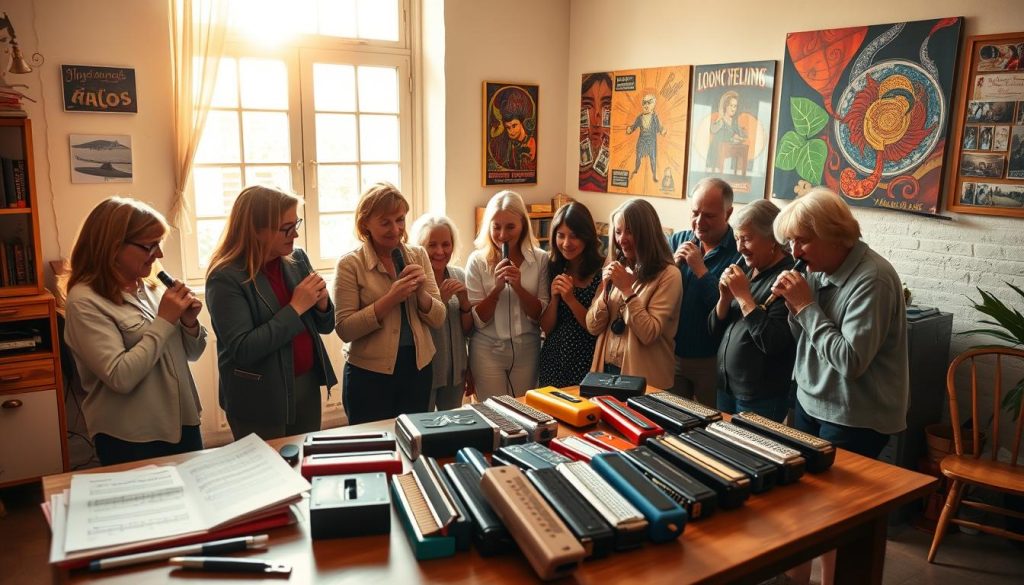
Monthly workshops with no software to install and recordings available
Format: a monthly session with six to eight participants, focused on practical needs and targeted corrections. No installation is needed: a secure link sent by email is enough. Sessions are recorded and available on the platform.
- Personal advice and answers to difficulties you encounter.
- Regular milestones to maintain motivation despite a busy schedule.
- Access from a PC, Mac or tablet, in France or abroad, with lessons and workshop recordings in one place.
- Feedback on tone, rhythm and musicality to speed up audible progress.
Learn from recognized teachers and artists
Learning from recognized artists brings a fresh perspective to technique and interpretation. The catalog includes lessons by Jean-Jacques Milteau and Charlie McCoy. Each brings a distinctive style and teaching approach.

Jean-Jacques Milteau and Charlie McCoy: blues and country references
Milteau covers blues standards in an accessible progression. His demonstrations explain expressive effects and good habits for performing on stage.
McCoy presents characteristic country techniques and songs. His lessons focus on phrasing, articulation and effects typical of the style.
- Trusted teaching: two recognized artists offer reliable, inspiring instruction.
- Complementary styles: blues and country broaden your range of sounds and repertoire.
- Practical approach: each lesson connects a technique to a specific piece, training your ear and playing.
- For every level: a progression beginners can follow, with room to refine your playing.
“Teaching good habits gives people the freedom to express their own sound.”
The result: a more defined sound and solid foundations for exploring other styles with confidence.
Lesson formats and platform: unlimited access on every device
The platform offers unlimited access and navigation designed for learning quickly, even on the move.
Clear lesson structure with short, focused lessons
Lesson structure
Chapters are brief and focused. Each unit sets out a specific goal.
Progress markers show you exactly what to work on.
iOS and Android apps and a dedicated learning space
Online access is synchronized across phones, tablets and computers. Students can find their history and workshop recordings wherever they are.
Sheet music, tabs, backing tracks and interactive tools
Resources include sheet music, tabs and ensemble-style backing tracks for harmonica practice.
Videos can be slowed down and looped. The tools show note positions and breath control.
Ease of learning: everything is gathered in one dedicated space. This modular method addresses specific needs without scattering your attention.
Pricing, access and guarantees: an affordable path into music
Get started quickly with a complete program that structures your practice without costing a fortune.
Immediate access to the modules
Access begins as soon as secure payment is complete: your account is created automatically and all modules become available.
You can watch the videos, download the learning packs and start at your own pace.
Offer, contents and guarantee
Example offer: six months of lessons and six 90-minute workshops for €199 before tax. This replaces the equivalent of several hundred euros’ worth of private lessons.
- How it works: secure payment, automatic account creation and immediate access to all six modules and videos.
- Contents: lessons, learning packs, sheet music, tabs, backing tracks and workshop recordings.
- Guarantee: a 30-day money-back guarantee to try the method without risk.
Flexibility: revisit lessons whenever you like, ask questions in workshops and track your progress through six milestones. The program is accessible from a PC, Mac or tablet in several French-speaking countries.
Action plan for starting today
Take the first step with a simple, specific plan for your first day of learning. By following these steps, you can turn your wish to play into a quick, concrete and motivating result.
Step by step: sign up, download, attend a workshop
Choose a ready-to-play 10-hole diatonic harmonica in Bb that suits the lessons.
Create your account during secure checkout for immediate access to the six modules. Download the five-video Starter Pack so you can begin practising without delay.
Quick goal: play your first tune in less than an hour
Set aside an hour for the guided sequence. The videos show each movement, and the accompaniment helps you play a recognizable first tune quickly.
- Schedule 10 to 20 minutes of practice a day, three to five times a week, to make progress.
- Sign up for the next workshop: join through an emailed link, with no installation required, and receive live feedback.
- Use the recordings and backing tracks to repeat key passages.
- Follow the method: meet one goal per lesson before adding effects.
Expected result: a first tune today, followed by steady weekly progress through the “navigation weeks.”
Conclusion
This course offers a practical approach to achieving a musical result quickly. With five focused videos, you can play a first tune in less than an hour, then continue with six modules available immediately.
The aim: a confident start, clear lessons, step-by-step rhythm practice and techniques that serve musical expression.
The repertoire mixes familiar tunes and original compositions so you learn by playing music. Workshops, recordings and the community support your practice and help you improve.
Simplicity: unlimited access on mobile and computer, with sheet music, tabs and backing tracks that are easy to use. It is an affordable, practical way to enjoy playing harmonica, even when time is limited.
Get a harmonica in Bb, create your account, start the five-video pack and join a workshop to reinforce what you have learned. Build a solid foundation today for exploring styles, nuance and improvisation in the weeks ahead.