
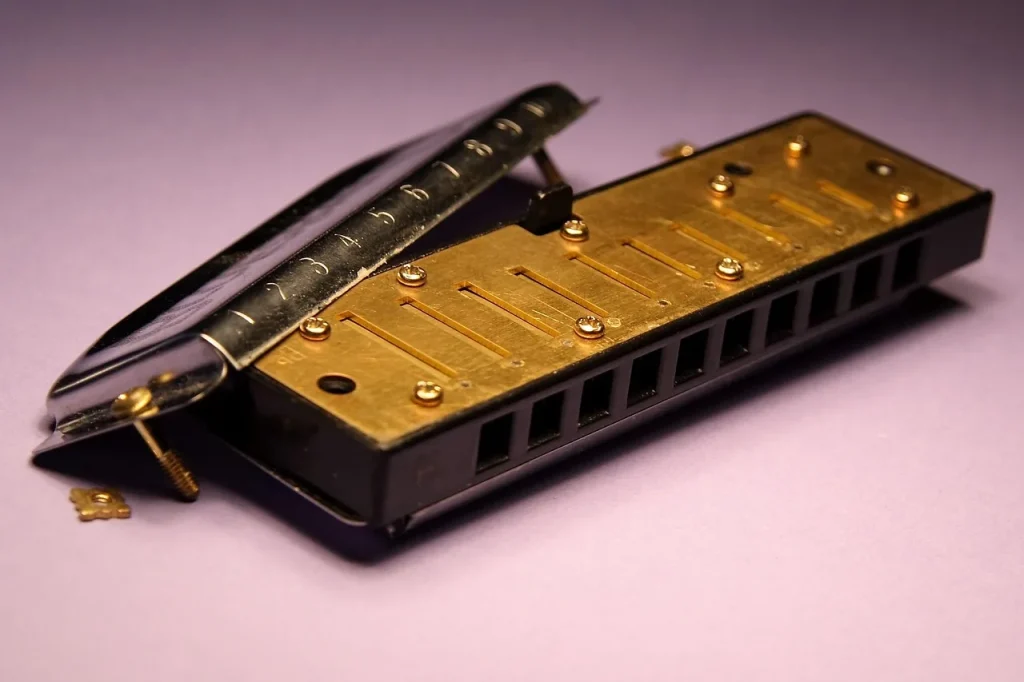
The model recalls the 1950s and delivers on its promise of comfort from the first time you pick it up. Handcrafted in Germany, it has domed covers that extend over the comb to the mouthpiece, providing lasting comfort.
Designed for jazz and melodic playing, this instrument uses 12-tone equal temperament (12TET). This tuning makes it easier to combine melodies and chords and helps avoid harmonic surprises on stage or in the studio.
Its technical features add to its reliability: an injection-molded red plastic comb, 0.9 mm brass reed plates and 20 reeds for a quick response and better airtightness. Replacement reed plates are available, reducing maintenance costs.
Used by Howard Levy, Carlos del Junco and Sébastien Charlier, it has become a benchmark for soloists seeking accurate pitch, a clean attack and steady sustain.
An overview of the Golden Melody and its benefits for soloists
The Golden Melody offers a fresh approach to melodic playing, combining accurate pitch with comfort from the first time you pick it up.
Its equal-tempered tuning (12TET) provides consistent pitch across the entire range. The 0.9 mm brass reed plates offer a quick response and smooth transitions from one note to the next.
For musicians who play jazz, pop or improvised music, the model makes harmonies easier to navigate and phrasing more fluid. It also supports overblows, which are useful for advanced techniques.
Its main benefits at a glance: 12TET for consistent tuning, rounded covers for comfort, responsive reed plates and compatibility with a wide range of techniques.
“A consistent tone and feel across all the holes: useful when transposing the same musical passage into different keys.”
Available in all 12 major keys, it lets players assemble a consistent set for the stage. The estimated shipping time is 5 to 7 days, useful when planning sessions or concerts.
Design and construction: what makes the Golden Melody distinctive
The design evokes a retro style while meeting modern demands for precision.
Rounded shapes and domed covers: the covers fit comfortably against the lips and in the palm. They reduce fatigue and help keep the instrument steady during long concerts.
Injection-molded red plastic comb: this material provides dimensional stability. The comb resists moisture better than wood and keeps the holes aligned over time.
Construction and materials
The 0.9 mm brass reed plates are milled for a precise fit. Reducing air leaks improves the attack and makes bends more predictable.
- 20 reeds for a dynamic response.
- Hand finishing by a brand known for its tight tolerances.
- Replacement reed plates are available, reducing long-term maintenance costs.
“Every design detail serves a purpose: better airtightness, even sound projection and immediate comfort.”
| Feature | Practical benefit | Effect for the musician |
|---|---|---|
| Domed covers | Fit the lips and hand | Less fatigue, more secure grip |
| Red plastic comb | Dimensional stability | Less sensitive to moisture |
| 0.9 mm brass reed plates | Milled for better airtightness | Clear attack, reliable bends |
| German manufacturing | Strict quality control | Durability and long-term consistency |
12TET equal-tempered tuning: accurate notes and consistent chords
12TET tuning provides a stable foundation for changing keys without unexpected intonation issues. It divides the octave into equal semitones, making notes more interchangeable and harmonic transitions more predictable.
Why 12TET suits melodic playing and jazz
12TET keeps intervals consistent across the full range. For melodic playing, that means fewer surprises when moving from a melody to a chord.
Chords, melodies and the realities of factory tuning
In practice, some harmonicas leave the factory with slight intonation differences. A small retuning can improve accuracy without changing the temperament. Deliberately lowering the pitch of certain reeds to favor a chord can affect the melody.
- Benefit: overall consistency that is useful in jazz and for layered polyphonic playing.
- Precaution: a technician can check and adjust the instrument.
- Remember: the musician’s musical intent and technique matter as much as the instrument.
“A properly adjusted 12TET harmonica avoids compromises and supports expressive playing.”
Golden Melody and overblows: ready for advanced techniques
Producing stable overblows depends as much on the instrument’s construction as on the musician’s practice.
The 0.9 mm brass reed plates, milled for a precise fit, reduce air leaks. This improved airtightness makes blown and drawn bends easier to produce, helping make overblows more consistent and musically useful.
Hand finishing and German manufacturing help ensure careful reed alignment. Precise factory setup limits leaks and improves the clarity of the attack.
Used by Howard Levy, Carlos del Junco and Sébastien Charlier
These artists’ use of the instrument shows that it meets the demands of advanced chromatic playing. Their concert and video performances show its suitability for solo playing.
- Practical benefit: access to more altered notes without changing instruments.
- Ergonomics: domed covers allow quick movements of the mouth and hand.
- Tip: work on sealing the air channel, then on a steady breath to stabilize intonation.
“A slight reed adjustment by the manufacturer or a technician can further improve reliability in real-world playing.”
| Component | Effect | Playing benefit |
|---|---|---|
| Milled 0.9 mm reed plates | Fewer air leaks | More stable overblows |
| Precise factory setup | Reed alignment | Clean attacks, reliable intonation |
| Domed covers | Comfort and mobility | Easier rapid passages |
On stage and in the studio: styles, playing and tonal nuances
On stage or in the recording booth, it delivers a consistent, controlled sound.

From jazz to blues: attack, sustain and note accuracy
Precise attacks and even sustain make studio recording easier. Notes come through clearly, without unwanted whistles, reducing postproduction time.
Stable tuning and an even response make playing easier across all registers. From pianissimo to fortissimo, the pitch remains usable in a dense mix.
In jazz, this supports transitions between melodies and chords, spare voicings and chromatic passages produced with advanced techniques.
In blues, it delivers strong attacks, deep vibrato and controlled bends that are easy to work into an arrangement.
“A consistent tone makes successive takes easier and simplifies edits in the studio.”
- Practical advice: alternate rhythmic patterns and melodic lines to test its stability across different passages.
- Tip: record a short video of your sessions and compare takes to improve your articulation and musical expression.
| Setting | Sonic strength | Use for musicians |
|---|---|---|
| Studio | Clear notes, low noise | Fewer corrections, takes that are easy to edit together |
| Stage | Consistent tone over time | Reliability during concerts |
| Jazz | Even response | Supports voicings and chromatic playing |
| Blues | Effective attacks and bends | Presence in the mix |
Golden Melody: why this harmonica appeals to soloists
For a musician seeking consistency, this model offers practical technical solutions.
Main reasons: consistent tuning from 12TET, comfortable covers, support for overblows and components designed for performance.
Discerning customers often report a clean attack, even tone and straightforward maintenance thanks to the available replacement reed plates.
On stage, the comfortable grip and full-coverage covers reduce snags. This helps project a clear melody within a band without compensating for intonation differences.
Some models have few public reviews. That says nothing about their performance, but it is a reason to try them and document your experience.
In practice, availability in all 12 major keys makes it easier to build a consistent set.
“An instrument designed for soloists: precision, comfort and reliability in service of musical expression.”
Tip: compare video recordings of your playing to assess articulation, attack stability and how well bends hold across several keys.
A quick comparison with other diatonic harmonicas
A focused comparison highlights its strengths and limitations alongside competing models. Here, the focus is on temperament, comfort and versatility for playing on stage or in the studio.
Compared with Lee Oskar and other brands: temperament, comfort and versatility
Temperament: the model uses 12TET tuning, which helps keep chords and melodic lines harmonically consistent. By comparison, Lee Oskar sometimes favors setups designed for flexibility on stage.
Comfort: the rounded covers and comfortable grip make fast passages easier. Many musicians appreciate this ergonomic design inherited from the 1950s.
Versatility and projection: the 0.9 mm reed plates and careful machining deliver a clear attack. The sound cuts through a mix, which is useful in jazz and blues.
“A well-adjusted 12TET harmonica makes it easier to keep chords and melodies consistent, though other brands may suit different musical aims.”
| Criterion | Benefit | Comparison |
|---|---|---|
| Tuning | Stable 12TET | Lee Oskar: more variants |
| Ergonomics | Domed covers | More traditional designs from other brands |
| Available range | 12 keys | Lee Oskar: wider range |
Availability, keys and buying experience
When building a consistent set, knowing stock levels and delivery times matters as much as knowing the instrument’s sound qualities.
Availability: the model comes in all 12 major keys. This makes it possible to assemble a set of harmonicas suited to most performance needs.
12 major keys, online stock and estimated delivery time
Check online stock before buying. The estimated delivery time is 5 to 7 days, useful information when planning rehearsals and concerts.
Note: only a few left in stock! If a particular key is essential to a project, order ahead.
- Consider ordering replacement reed plates to extend the instrument’s life.
- If no reviews are available when you buy, document your experience and share a structured review.
- Compare your favorite keys on video to choose the tone that best serves your musical intent.
“Checking the reference tuning at 440 Hz on arrival helps confirm pitch accuracy and identify any adjustments needed.”
| Consideration | Advice | Benefit |
|---|---|---|
| 12 keys | Build a consistent set | Maximum coverage for the group |
| 5-to-7-day delivery time | Check online stock | Plan rehearsals and concerts |
| Last few items | Buy ahead | Avoid a stock shortage before a concert |
| Maintenance | Order replacement reed plates | Extend the instrument’s life |
Reviews, limitations and everyday maintenance
With use, everyday experience reveals both strengths and points to watch.
What players like and what can cause problems
Reviews highlight superior comfort, clear articulation and a solid feel. Many customers appreciate the stability of 12TET for solo playing.
However, some instruments leave the factory with reeds set too low. In those cases, a slight adjustment is needed to correct the tuning.
Retuning, airtightness and reed life
Signs of an airtightness problem include needing to blow harder, tiring quickly or getting an uneven response from one hole to another.
- Regular maintenance: cleaning and checking the screws.
- Check reed alignment and replace the reed plates if the response weakens.
- Retuning: use a reliable tuner, make small adjustments and test the instrument after each one.
“Assess the instrument when cold and then when warm to detect changes caused by expansion.”
| Action | Frequency | Result |
|---|---|---|
| Cleaning | After every session | Better hygiene, fewer leaks |
| Checking screws and reed plates | Monthly | Airtightness and precision |
| Small adjustments | As needed | Accurate pitch and playing comfort |
Finally, experienced musicians recommend recording a short review and, if possible, sharing that video to add to the available feedback and help other players.
Conclusion
This model’s greatest strength is the balance between its construction methods and its immediate musical response. Its 12TET tuning, German manufacture with hand finishing, injection-molded comb and 0.9 mm brass reed plates support the melody, the attacks and the consistency of the chords.
It opens up possibilities for modern music: usable overblows and reliable notes when transposing. A few instruments may need slight retuning; this is a common issue that is easy to correct.
Trying the instrument in several keys, filming short videos and recording your impressions will help you compare attack, sustain and pitch accuracy over time. It remains a sound choice for anyone seeking a durable instrument with available replacement parts and good value over several years.