
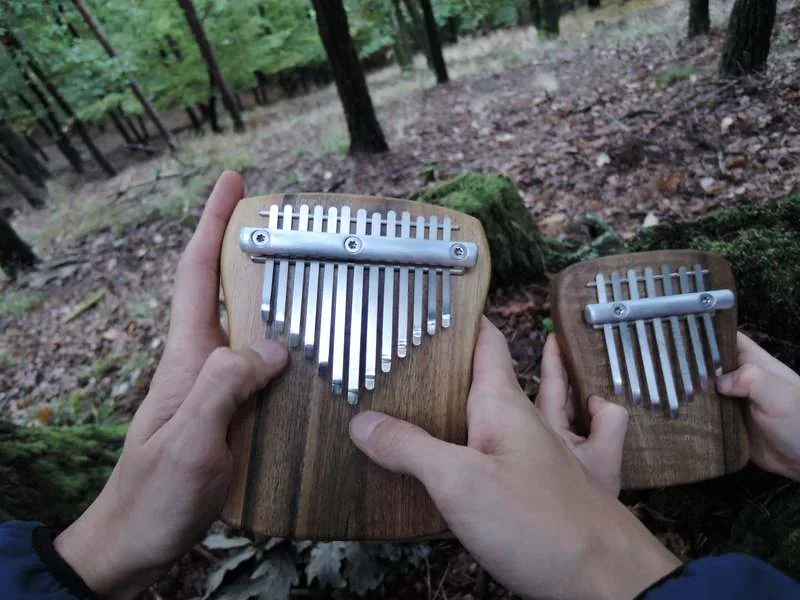
The kalimba is a small musical box fitted with metal tines. Each tine produces a note when plucked with a finger. It is easy to hold and feels gentle and almost intuitive to play.
Its history reaches back to the mbira, a traditional African instrument with roots dating back about 3,000 years. In the 1950s, Hugh Tracey adapted this model to create the modern kalimba. His adaptation brought an older tradition to a wider audience in the West.
At first glance, the instrument resembles a miniature piano. Its sound, however, does not come from strings: the tines vibrate when played with the thumbs. Their length determines the pitch of each note.
Read on to discover its parts, how it produces sound, how to tune it, and how it is used today. This kalimba appeals to players with its clear tones, compact size, and accessibility. For someone starting to make music, it offers a calming experience without demanding technical skill from the outset.
What is a kalimba and how does it work?
Before looking at how it is made, it helps to understand what kind of instrument it is. It is called a thumb piano because of the movement used to play it. Yet it has no hammers, strings, or keyboard like those of a conventional piano.
The thumb piano and its gentle sound
Each tine corresponds to a particular note. Hugh Tracey’s modern model had 15 keys. This layout makes melodies intuitive to follow: each pluck produces a clearly identifiable pitch.
The term finger piano also appears in some accounts of Europeans discovering this African instrument. Today, its crystalline tones accompany gentle music, personal playing, and early musical exploration.
A percussion instrument in the idiophone family
In instrument classification, it is more precisely a percussion instrument belonging to the idiophones. The vibration arises directly in the metal tines, without a string or membrane. This distinguishes idiophones from wind and string instruments.
The term lamellophone makes the classification more specific. Each metal tine is its own sound source, producing a short, distinct, gentle tone.
From the traditional mbira to the modern kalimba
From its African roots to the French music scene, this instrument has a rich history. Each name carries a part of its heritage, region, and musical practice.
The African origins of the thumb piano
The mbira may have emerged in sub-Saharan Africa about 3,000 years ago. Its wooden body often measures around 20 × 15 × 2 cm. Its tines are about 10 cm long, while some versions have around 30 keys.
“Music carries a living memory that reaches far beyond sound.”
Hugh Tracey’s adaptation in the mid-twentieth century
British ethnomusicologist Hugh Tracey encountered the mbira in the former Southern Rhodesia, now Zimbabwe. In the 1950s, he adapted its structure to create a more regular scale. He then popularized the name kalimba for Western audiences.
This standardized version made the thumb piano easier to learn. It retained the principle of plucking tines with the thumbs. To explore the history of the kalimba further, it helps to distinguish modern use, local traditions, and cultural heritage.
Kalimba, mbira, sanza, and other names
Names vary by region: mbira in Zimbabwe, sanza or senza in Cameroon, likembe in Congo, and karimba in Uganda. These instruments share similar principles but are not always identical. In 2020, UNESCO added traditions of making and playing the mbira to its world heritage register. The kalimba therefore belongs to a much broader history of world music than its image as a little piano suggests.
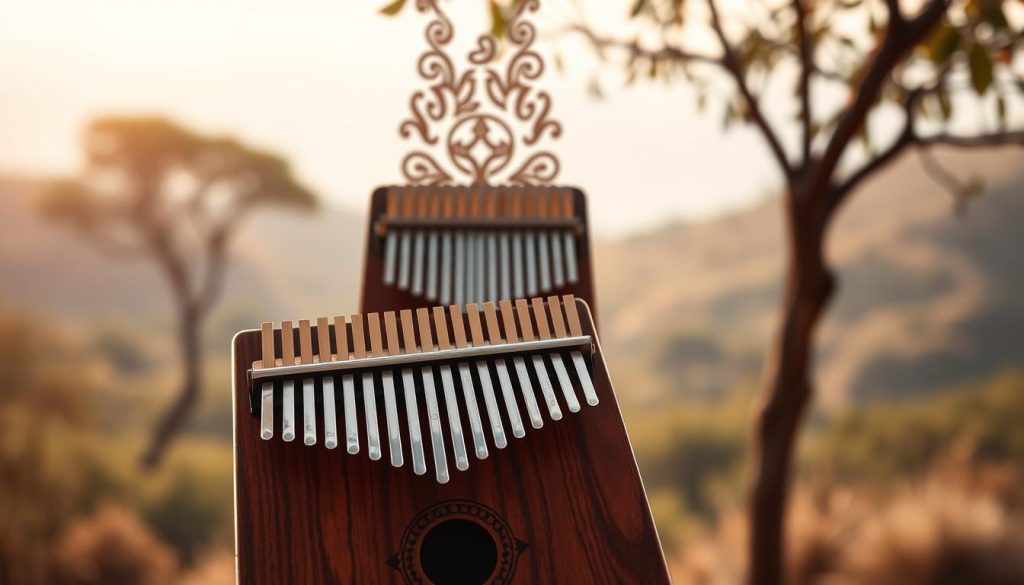
The parts of this musical instrument
To understand its sound, first look at the visible parts. Their shape, material, and attachment affect how the instrument responds. A kalimba brings together several simple components designed for easy handling.
Metal tines and musical notes
Modern kalimbas often have 17 keys, compared with 15 on Hugh Tracey’s original model. Compact versions offer 5, 7, or 10 tines. Chromatic versions may have several dozen.
Each tine corresponds to a note. Its length sets the pitch: a short tine gives a high note, while a long one produces a low note. The metal vibrates clearly when plucked.
Bridges and the pressure bar
Two bridges support the metal tines. A pressure bar holds them between two points. This attachment keeps the tension stable, limits sideways movement, and helps the instrument play consistently.
Wood, soundboard, and body
The soundboard may be made of wood, such as oak, maple, or bamboo. Acrylic is a modern alternative. A solid board gives a direct sound. A hollow body increases resonance. To learn more, see this guide to the instrument.
| Part | Role | Variations |
|---|---|---|
| Tines | Produce notes | From 5 to several dozen |
| Bridges | Support the tines | Two supports |
| Soundboard | Project the sound | Wood or acrylic |
How do the tines produce vibrations and sound?
The movement looks simple, but each part of it matters. To play, the thumbs press down on a steel tine. This bends it slightly before releasing it. The tine springs back and then oscillates rapidly up and down.
These vibrations move the air around the tine. A sound wave forms and reaches the ear. The metal therefore creates the sound directly. This principle makes the kalimba a percussion instrument classified as an idiophone. The name finger piano refers only to the movement used to play it.
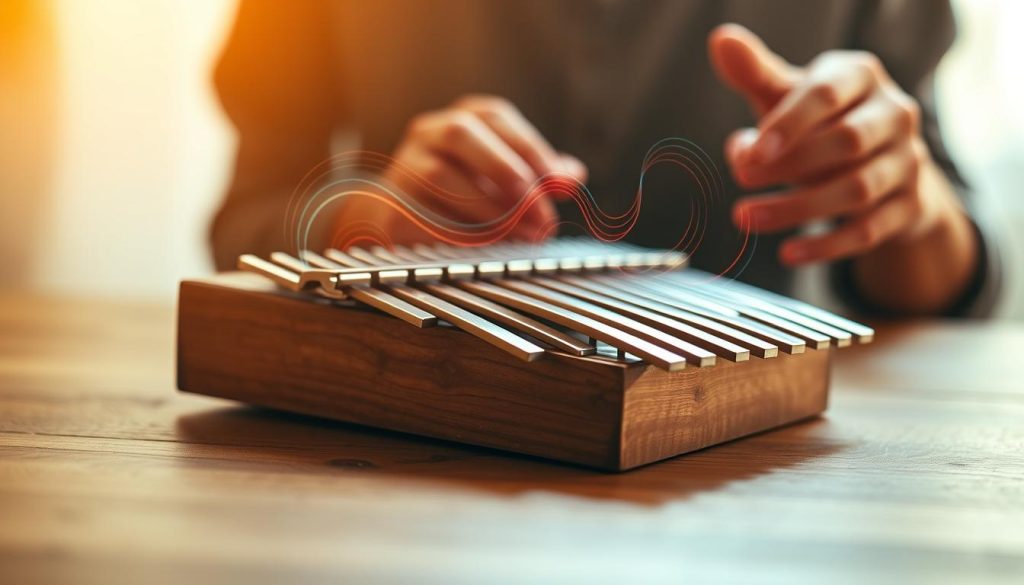
The bar holds each key in place while preserving the flexibility it needs. Some of the movement passes into the soundboard. With a hollow resonator box, the sound becomes fuller. Volume therefore depends on the shape, the wood, and the force applied.
About 3,000 years ago, some traditional models used bamboo tines. Steel later became common because of its durability and precision. Today’s kalimba retains this old principle. Each tine makes its own note, while the body projects the music. In this way, the kalimba turns a simple pluck into a living sound.
How key length and tuning affect pitch
The pitch of a note depends mainly on the length of the vibrating section. This makes the kalimba easy to understand, even without musical training. Each key is reminiscent of a piano key, with its own pitch.
Short tines for high notes and long tines for low notes
A short tine vibrates faster and produces a high note. A long tine oscillates more slowly and produces a low note. This pattern helps the thumbs find notes while playing.
On a typical model, 17 tines often form a diatonic scale. To explore this layout further, see this practical kalimba guide.
Adjusting the tines with a tuning hammer
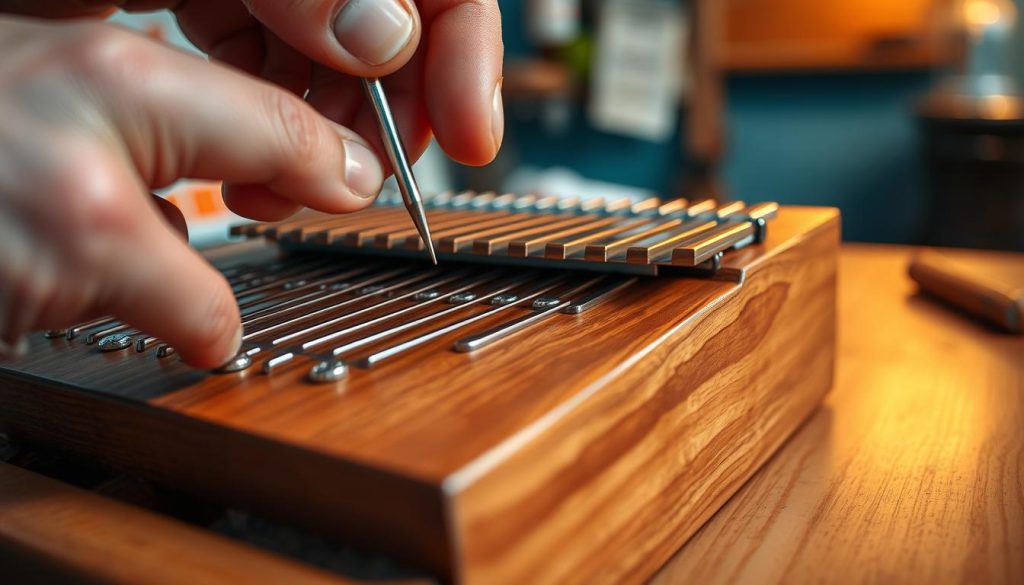
The tines slide between two bridges. Moving a tine upward shortens its vibrating section; moving it downward lengthens it. A tuning hammer allows small, gradual adjustments. The pressure bar maintains stable tension during tuning.
“Good tuning turns every sound into music.”
| Element | Action | Result |
|---|---|---|
| Short tine | Fast vibration | High note |
| Long tine | Slow vibration | Low note |
| Hammer | Precise movement | Accurate tuning |
The differences between a flat kalimba and one with a resonator box
The design changes the character of this instrument’s sound. A flat model uses a solid wooden board with no internal cavity. A box model has a hollow resonator box with a sound hole.
This distinction can guide your choice of kalimba. The flat model offers a direct, quiet sound, rather like a small piano. A box model is better suited to playing for several people.
Volume and how vibrations spread
Inside a hollow box, sound waves reflect off the walls. This increases resonance and helps project the sound while also affecting its tone. The stated volume is generally between 75 and 90 decibels, roughly comparable to a lively conversation.
The quality of the wood also affects how the tines respond. A light touch is often enough to produce a clear tone. In this respect, the kalimba resembles other African instruments, such as the mbira and sanza.
Wah-wah and vibrato effects made with the sound holes
The front hole acts as an acoustic opening. Partly covering it with a hand creates a wah-wah effect. Two holes at the back can also produce vibrato: the fingers cover and uncover them at the desired rhythm.
These movements give kalimbas more expression. They turn the body into a musical tool without changing the tuning of the tines.
How do you play the kalimba, and where is it used?
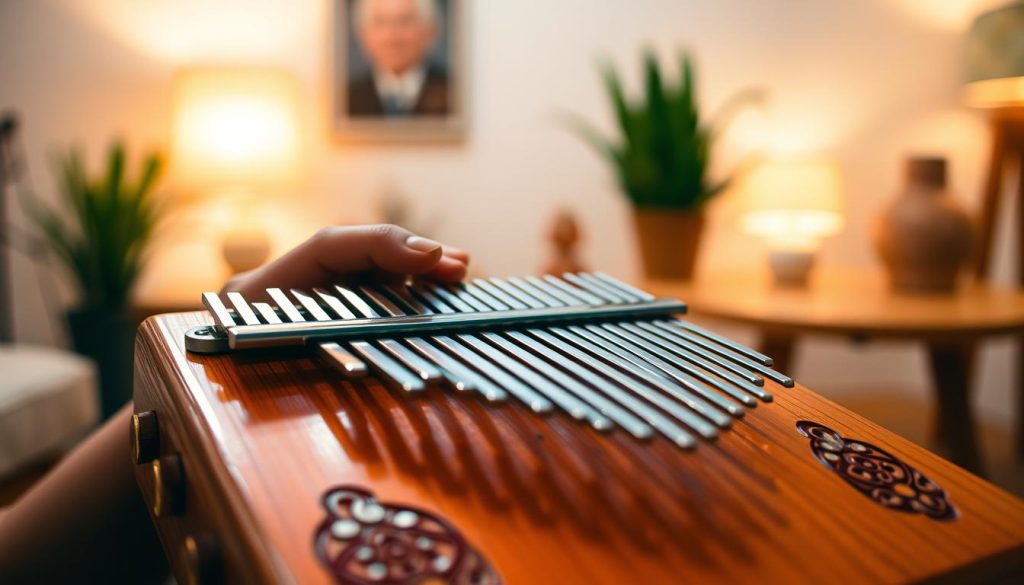
It takes little time to get comfortable holding one. Hold the body with both hands, then alternate your thumbs across the metal keys. Each pluck releases a distinct vibration. Markings on the tines help you remember the notes.
Using the thumbs to make the keys vibrate
Start with a slow melody on a 17-tine model. This thumb piano has an intuitive layout. A light touch is enough to produce clear notes. To add expression, briefly cover the openings to create a wah-wah effect or vibrato.
An accessible instrument for musical discovery and relaxation
From age three, the instrument can encourage children to discover rhythms. Its gentle sounds can also accompany meditation. A wooden resonator box produces a warm tone. These uses suit beginners and anyone looking for a quiet break.
World music, ensembles, and music therapy
In world music, jazz, folk, and contemporary compositions, kalimbas add a recognizable sound. Maurice White, David Bowie, and April Yang have helped bring them to wider attention. Music therapy may support relaxation, emotional expression, coordination, and fine motor skills. The mbira also accompanies weddings, official ceremonies, and Shona practices.
“Each note opens a space to listen, breathe, and create.”
To continue exploring, see this complete guide to the instrument.
Conclusion
A small box can carry a long musical memory. The kalimba is an African musical instrument descended from the mbira, whose roots reach back about 3,000 years. Today, its name is known far beyond its place of origin.
In the 1950s, Hugh Tracey popularized the modern thumb piano. Metal keys of different lengths vibrate after each pluck. Each produces a clear note. The resonator box amplifies the sound, while its openings allow wah-wah and vibrato effects.
Its straightforward playing technique makes it accessible to beginners. Kalimbas therefore have a place in early musical learning, relaxation, world music, and music therapy. Their use carries a tradition forward while allowing it to evolve.
For a structured introduction to this thumb piano, see this beginner’s guide. Careful listening is often enough to help you improve, choose your instruments, and keep this rich tradition alive.