

A small thumb piano from Africa, the kalimba captivates listeners with its clear, soothing notes. Its compact size makes it easy to handle, even for beginners. Today, many people use it to create a gentle atmosphere at home.
Its history goes back to the mbira, an African instrument about 3,000 years old. In the 1950s, British ethnomusicologist Hugh Tracey developed a modernized version. This adaptation became known as the kalimba and helped spread the instrument worldwide.
How does it work? Metal tines vibrate when plucked with the thumbs. Each key produces a distinct note. Playing the kalimba can therefore feel simple, intuitive, and enjoyable from the very first minutes.
This guide covers the essentials: origins, construction, tuning, care, and uses. It also explains how the instrument works and how loud it is, often between 75 and 90 decibels. In a short time, anyone can better understand its possibilities and choose an approach suited to their level.
Kalimba: Everything You Need to Know About This Musical Instrument
With its metal keys and compact body, the kalimba offers a simple introduction to the thumb piano. Each tine produces a clear note without strings or complicated movements. Its lightweight design suits many people, whether at home or traveling.
A thumb piano with soft, melodic tones
A modern model often has 15 or 17 keys. Its sound resembles that of a small piano, with a rounded, soothing resonance. Volume generally reaches 75 to 90 decibels, depending on the wood, body, and playing technique.
Each key corresponds to a musical note. Simply pluck the tines with your thumbs to create a short melody. This immediate response makes the instrument enjoyable to explore.
Why beginners love this instrument
You can play your first songs quickly, even without knowing how to read music. Learning gradually helps you identify the notes and then coordinate both hands. Beginners can start with a few simple patterns.
- easy and comfortable to hold;
- gentle sounds suited to indoor use;
- a convenient format for beginners.
In this way, the kalimba turns every session into a creative, relaxing moment.
The African origins of the kalimba
Long before it reached Europe, this instrument accompanied stories and ceremonies in sub-Saharan Africa. Its ancestor, the mbira, may have appeared about 3,000 years ago. This small percussion instrument often has a wooden base measuring about 20 × 15 × 2 cm.
The mbira, the traditional ancestor of the thumb piano
Its tines, about 10 cm long, vibrate beneath the fingers. Their number ranges from just a few to around thirty. Each key produces a note, with a tone shaped by the wood and resonator. This tradition forms part of the history of instrument families.
Hugh Tracey’s creation
After discovering the mbira in Southern Rhodesia, now Zimbabwe, Hugh Tracey adapted it. In the 1950s, he created a model accessible to Western audiences. His first kalimba had 15 keys arranged in one row and tuned to a familiar scale.
Names that vary by region
Names vary among communities: mbira in Zimbabwe, sanza in Cameroon and Congo, and sansula, likembe, or karimba elsewhere in Central Africa and Uganda. Hugh Tracey helped introduce the kalimba to the wider world.
How this instrument is built and how it works
A simple touch of the thumb makes the instrument vibrate. To understand the kalimba, it helps to look at its parts, their roles, and their influence on the sound. This can also help you choose a model.
Metal tines, keys, and the pressure bar
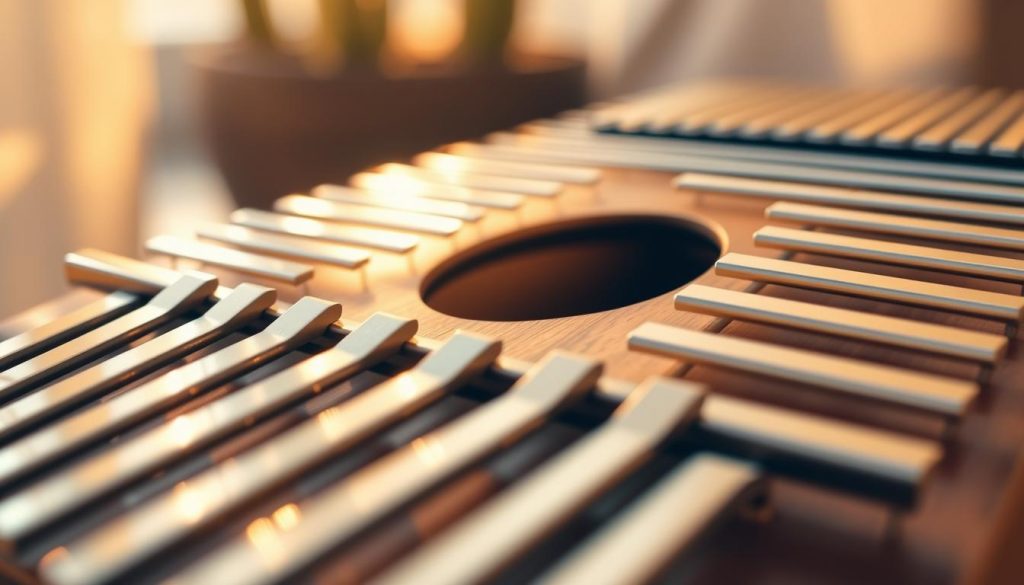
Each steel tine corresponds to a note. Together, they form the keys that the thumbs gently pluck. Two bridges support them, while a bar holds them against the soundboard. Positioned between two supports, this bar keeps the tines in place and prevents them from coming loose.
The role of the bridges and resonator
The bridges transmit vibrations to the base. It may be made of wood or clear acrylic. In a hollow model, the resonator amplifies the sound through its interior space and front opening.
The front hole can produce a wah-wah effect. Two openings at the back can also create vibrato. The kalimba thus lets players vary its resonance without a complex mechanism. To learn more about how it works, see this practical guide.
Different kalimba models to explore
Choosing a kalimba starts with the shape of its base and then depends on the volume you want and how comfortable it feels in your hands. Each instrument responds differently.
Flat or hollow kalimba: choosing between a board and a resonator box
A flat model consists of a simple wooden board without a resonator box. Light and easy to carry, it offers a direct playing feel. A hollow model has a resonator box with a front opening. It generally produces a fuller resonance but weighs slightly more.
Volume, portability, and comfort can therefore guide your choice:
- flat: simplicity, light weight, and a quieter sound;
- hollow: greater sound projection and stronger bass;
- resonator box: a good choice for expressive playing.
Number of tines, musical scale, and key layout
Common formats have 5, 7, 10, or 17 keys. A 17-tine model offers a wider range, while a chromatic version has several dozen tines. They may be arranged in one, two, or three rows.
The length and position of each tine affect its tuning. To compare kalimbas systematically, see this practical guide.
The kalimba’s instrument family and sounds
Its musical classification rests on a simple principle: sound comes from a material that vibrates. The kalimba therefore belongs to the percussion instruments, more specifically the idiophones and lamellophones. The metal tines themselves produce each note when plucked with the thumbs.

Unlike a traditional piano, it has no strings or membranes that produce sound. A resonator box can nevertheless increase its projection while preserving its soft timbre. The sound level generally reaches 75 to 90 decibels, depending on the model, material, and playing strength.
Its name also varies by region. It may be called a thumb piano, finger piano, or sanza. These names refer to closely related forms whose layouts and scales sometimes differ. To distinguish the versions, explore this guide to the thumb piano.
Its sound suits meditative settings, world music, and intimate arrangements. The kalimba can therefore accompany a quiet break or become part of a melodic composition.
What the thumb piano is used for today
Today, the thumb piano has a place in many musical practices. Light and intuitive, it offers a quick way to create music. It suits beginners and experienced artists alike.
A solo or accompanying instrument in many styles
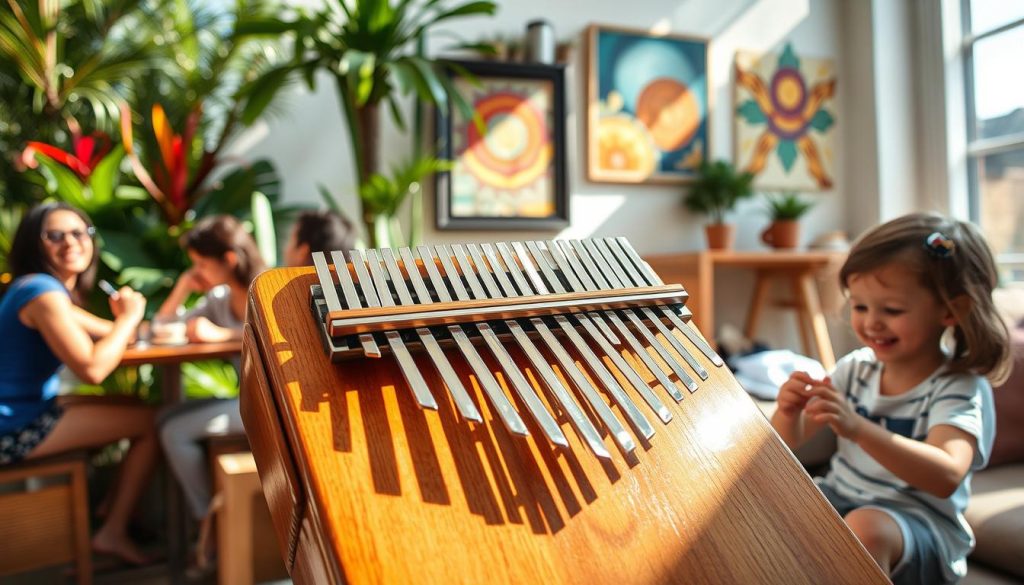
The kalimba can be played solo to create a meditative atmosphere. It also accompanies guitar, percussion, singing, or storytelling. Its sound fits world music, jazz, folk, and contemporary compositions.
Maurice White, David Bowie, and April Yang illustrate the variety of playing styles. This musical instrument can support a melody, enrich an arrangement, or create a gentle pause.
The benefits of music and music therapy
In music therapy, its soft sounds may encourage relaxation, stress management, and emotional expression. Plucking the tines also exercises fine motor skills. Individual, group, meditative, or rehabilitation sessions can suit different ability levels.
The mbira retains deep cultural significance among the Shona. Its ritual and social uses remain recognized, while the associated knowledge and skills have been on UNESCO’s global register since 2020. The kalimba thus connects contemporary creativity, well-being, and living heritage.
How to play the kalimba as a beginner
A few simple movements are enough to get started. The kalimba responds quickly, making each session enjoyable for beginners.

Holding the instrument and plucking the tines with your thumbs
Rest the thumb piano against your palms without gripping it tightly. Keep your wrists relaxed. Pluck each tine with your thumbnail rather than the tip of your thumb. This position produces a clear sound and reduces fatigue.
Alternating hands and memorizing the notes
Start with your right thumb, then let your left thumb take over. Alternating them creates steady arpeggios. Colored markers on the keys can also help you memorize the notes.
To play the kalimba, proceed slowly. Repeat a short measure, then add another. After a few hours, a beginner may be able to play a complete melody. This approach makes learning more motivating.
Using tablature and tutorials to improve
Tablature shows the order of the keys without requiring advanced music theory. Video tutorials demonstrate the movement and rhythm. See this guide to playing the kalimba, then explore methods for beginners.
| Step | Suggested action | Goal |
|---|---|---|
| Getting started | Hold it without tension | Stay comfortable |
| Rhythm | Alternate hands | Create a steady pattern |
| Progress | Follow tablature | Play a familiar tune |
Tuning and caring for the kalimba
An accurate sound depends on both tuning and everyday care. A few simple steps can keep this small instrument in good condition, even after several months.
Moving the tines with a tuning hammer
To correct a note, place the tuning hammer against the base of a tine. Moving the tine slightly upward shortens it and raises the pitch. Moving it downward lengthens it and lowers the pitch.
Work slowly, then check each note with an app or chromatic tuner. Retuning becomes useful over time, especially after changes in humidity or temperature. This precise adjustment prevents differences between the keys. You can also use this online kalimba tuning tool.
Cleaning, protecting, and storing your instrument
After each session, wipe the tines and wooden body with a soft, dry cloth. Avoid water, household cleaners, and scented wipes. They may dull the finish or encourage corrosion.
- store the kalimba in a closed case;
- keep it away from radiators and damp windows;
- check the tuning hammer before every long trip.
Proper storage helps kalimbas maintain a consistent sound.
How to choose your first kalimba
Before buying, consider your experience, what you want to play, and the space you have. A suitable choice makes your first melodies easier and learning more enjoyable.
Choose a beginner-friendly model
A 17-key model offers a good balance. It lets you explore several tunes without making the notes too difficult to find. Engraved or colored markers can also help during your first sessions.
To prepare for your purchase, see this beginner’s guide. It will help you choose a thumb piano that suits your pace.
Compare materials and sound quality
Oak, maple, and bamboo feel different to the touch. Acrylic offers a modern style. A resonator box often increases sound projection, while a flat model is convenient for travel.
Also examine the metal, the finish of the tines, and how well the instrument stays in tune. Instruments du Monde offers more than 200 models. You can find an instrument to suit your budget, preferred scale, or musical use.
| Criterion | Suggested option | Main advantage |
|---|---|---|
| Keys | 17 tines | Good balance for beginners |
| Base | Wood or acrylic | Different feels and styles |
| Resonance | Resonator box or flat design | Sound projection or easy transport |
Conclusion
Derived from the mbira, the kalimba connects African history with modern music-making. Its roots go back about 3,000 years. In the 1950s, Hugh Tracey popularized its present-day form.
Its metal tines, played with the thumbs, produce clear notes. Flat, hollow, 17-key, and chromatic models meet the needs of players at different levels.
Classified among lamellophones and idiophones, this musical instrument creates a gentle atmosphere. With tablature, anyone can play the kalimba quickly and then develop coordination and memory.
From the African sanza to contemporary designs, kalimbas hold a distinctive place among instruments. Choose a model suited to your level and play your first melody today.