
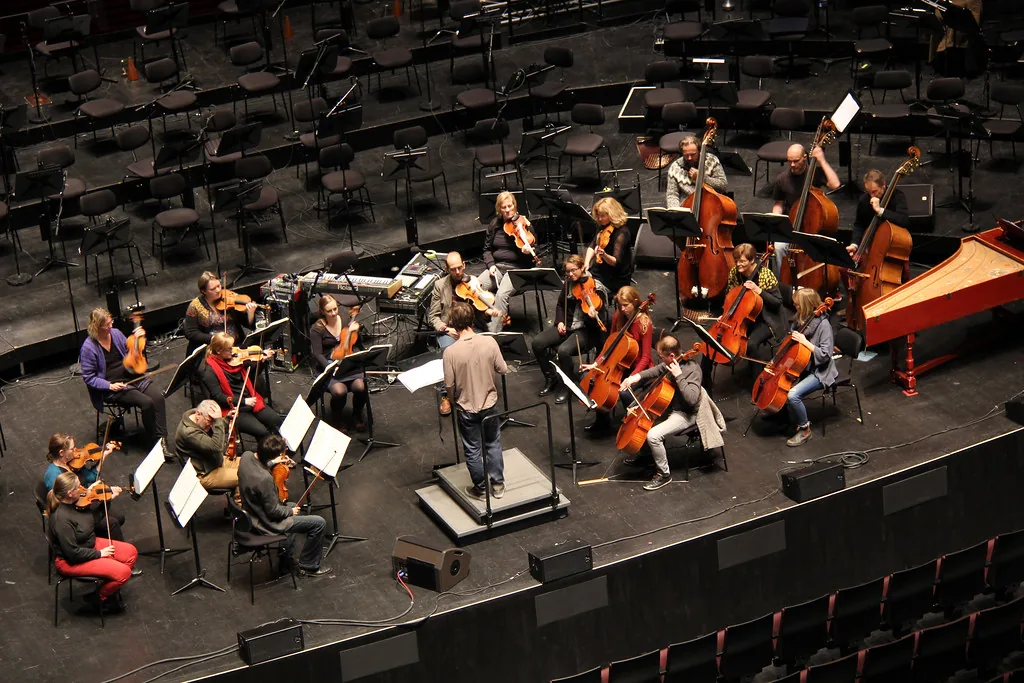
A symphony orchestra is a unique musical ensemble. It performs classical music for different audiences. It has more than eighty musicians, sometimes as many as a hundred, each playing an essential role in how the orchestra works.
It is made up of several groups of instruments. The strings, winds, and percussion are the main groups. There may be sixteen first violins, for example. The brass and woodwinds provide a wide variety of sounds. The orchestra also plays in operas and on soundtracks, showing its versatility.
What is a symphony orchestra and how does it work?
A symphony orchestra is an ensemble with a highly structured organization. It brings together more than eighty musicians. Each plays a key role in creating a collective performance.
The instruments are divided into four families: brass, woodwinds, strings, and percussion. The way musicians play together has changed over time. This evolution gives them more freedom to enrich their musical interpretation.
In the Baroque era, orchestras included strings, brass, and percussion, as well as instruments such as the harpsichord. Over time, instruments such as the xylophone and contrabassoon were added, enriching the sound. The organization of a modern orchestra helps listeners appreciate the music more fully.
The conductor plays a crucial role. They guide each musician to ensure a coherent musical interpretation. Rehearsals are essential for harmony and precision. They show the collective work behind a symphony orchestra.
Composition of the symphony orchestra
A symphony orchestra consists of four main instrument families. Each has a unique role. Together, they create the richness of symphonic music.
The instrument families
The instrument families are strings, woodwinds, brass, and percussion. This variety of sounds is crucial to performing orchestral works. A good balance among the families creates harmonious musical dynamics.
Strings in the orchestra
Strings, such as violins and cellos, form the foundation of the orchestra. Their players sit around the conductor, making communication easier and helping the sound carry. They often play essential melodies and harmonies.
Woodwinds and brass
Woodwinds and brass add a distinctive texture. Flutes and trombones, for example, create dramatic effects. Seated behind the strings, their players enrich the orchestra’s sound.
Percussion
Percussion plays a key role in rhythm. Timpani and cymbals add color and intensity. Their position at the back helps control their volume and blend them into the ensemble.
To learn more about the composition of the orchestra and how it has evolved, follow this link.
The history of the symphony orchestra
The history of symphony orchestras is marked by many changes. Ensembles have evolved considerably since the Baroque era. Early symphonies, such as those by Bach, laid the foundations for modern orchestration.
Evolution from the Baroque era to today
The Baroque era saw new instruments added to the orchestra. Brass and percussion enriched the music. The Classical period brought instruments such as the trombone and clarinet.
The Romantic period saw the orchestra grow further. Instruments such as the harp and tuba were added. This history of the symphony orchestra shows how music has evolved.
The major periods of classical music
The periods of classical music were crucial to the orchestra’s development. Composers such as Beethoven left their mark. Their influence is evident in today’s orchestras, which can have as many as a hundred musicians.
This evolution has brought great diversity. Modern orchestras use new instruments to create distinctive sounds.
In summary, the history of the symphony orchestra is rich and varied. From the Baroque sinfonia to the modern orchestra, each period has made its contribution. In this way, classical music continues to bring people together around the world.
| Period | Key instruments added | Characteristics |
|---|---|---|
| Baroque | Harpsichord, strings | A still loosely defined ensemble; emergence of the sinfonia |
| Classical | Trombones, clarinets | A more structured orchestra and a wider range of sounds |
| Romantic | Harp, tuba | A larger orchestra, with more percussion and wind instruments |
| Modern | Contemporary instruments | Flexible seating arrangements and varied sound effects |
The roles of musicians and conductors
In a symphony orchestra, musicians’ roles are varied and essential. Each musician, whether a violinist or a flutist, has a specific role and contributes to the orchestra’s rich sound. The hierarchy extends from the concertmaster to the conductors. Conductors provide musical direction and ensure a coherent interpretation of the works.
Musicians’ roles in the orchestra
Musicians fall into several categories:
- Featured soloists: they play specific solo parts in concerts but are not present in every orchestra.
- Section players: each section, such as the strings or brass, has many musicians who may play solos. Substitutes are available when a player is absent.
- Section leaders: principal violinists or trumpeters guide the other musicians. They communicate with the conductor.
- Tutti: all members, including soloists, are considered members of the orchestra.
The conductor’s role
The conductor plays a crucial role. They stand on a podium and keep time. They communicate with the musicians through precise gestures. Here are some key aspects of the role:
| Aspect | Details |
|---|---|
| Visibility | Stands so every musician can see them. |
| Gestures | Indicates the tempo and its changes, and gives important cues. |
| Types of conductors | Permanent conductors under contract or guest conductors invited for specific concerts. |
| Safety | Notable incidents highlight the importance of safety measures. |
The symphonic repertoire
The symphonic repertoire includes all the works performed by an orchestra. It ranges from older pieces to recent compositions. Classical works by Beethoven, Mozart, and Tchaikovsky are central to this repertoire. They show how orchestral music has evolved and influenced audiences.
Iconic works of classical music
Symphonies such as Beethoven’s Ninth and Tchaikovsky’s Fifth are widely known. Performed in concert halls around the world, they attract large audiences. Orchestras play these pieces to celebrate music and offer memorable experiences. For more detail on how modern orchestras engage audiences, visit this page.
The diversity of symphonic compositions
The diversity of symphonic compositions matters today. Concerts include recent pieces, such as film music. This allows orchestras to explore new sounds and attract new audiences. Their repertoire also includes lesser-known works that highlight new composers and styles. In this way, the symphonic repertoire continues to grow while honoring its origins.
Conclusion
The symphony orchestra brings music and communal life together. With 119 musicians, it can produce a wide variety of sounds from strings, winds, and percussion.
Each musician plays a key role in this harmony. Together, they represent the musical heritage of our time.
The “Figures de notes” series offers 17 videos that present a more human side of the orchestra. These ten-minute videos introduce the instruments and the stories behind them. They make music vivid and accessible.
Preparing a work shows that conducting involves more than simply leading the musicians. Pierre-André Valade, for example, builds connections between the musicians and their environment. To learn more, read this study.
The symphony orchestra continues to evolve with the times. It keeps musical tradition alive while adapting to the present.