
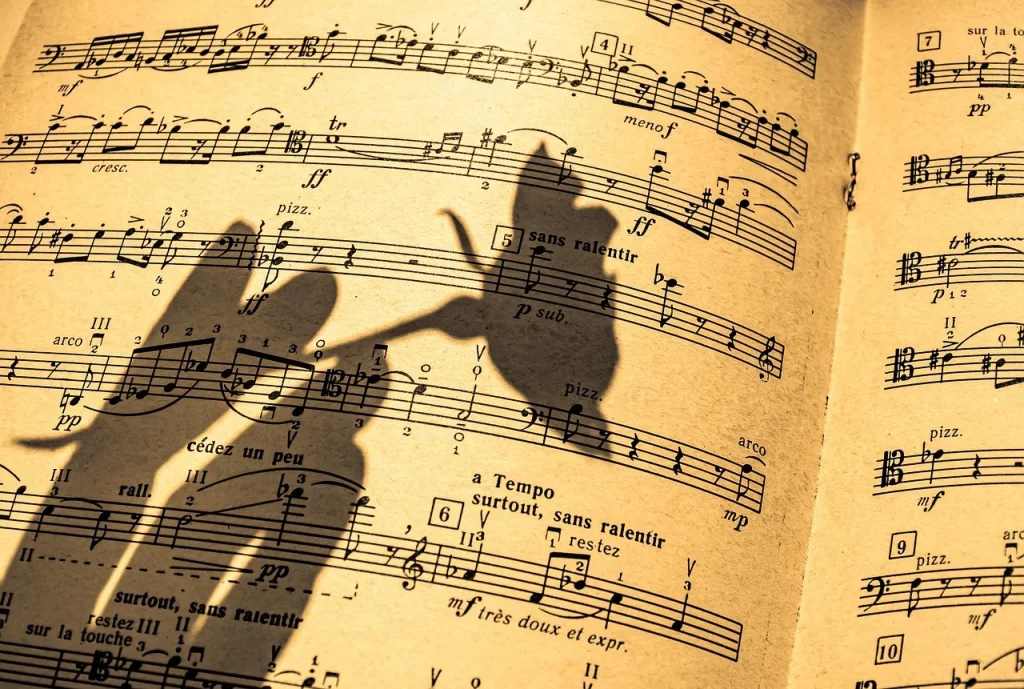
Music is a universal language that connects artists and listeners. Its structure rests on essential principles that are often invisible but bring the melodies we love to life. These foundations help us understand musical works and express our creativity more freely.
Learning these fundamentals opens doors, whether you are a beginner or an enthusiast. Modern tools, such as apps and children’s podcasts, make learning accessible and fun. They turn a complex subject into an engaging adventure.
This article guides you toward a clear, step-by-step understanding. Discover how great composers use these principles to create timeless masterpieces.
Introduction to music theory
Behind every captivating melody is an organized system of rules and principles. These foundations help explain how sounds come together to create emotion. They also provide a way to explore the works of great composers.
Why learn music theory?
As one expert puts it:
“Music theory explains how songs do what they do.”
It acts as a compass for:
- Analyzing existing pieces with a critical ear
- Developing your creativity as a composer
- Collaborating more easily with other musicians
Despite a common misconception, these rules do not limit artistic expression. Instead, they provide tools for organizing musical ideas.
The essentials to start with
Three pillars form the foundation of this learning process:
| Element | Role | Example |
|---|---|---|
| Melody | A sequence of notes forming a recognizable theme | The chorus of a popular song |
| Harmony | Chords that support the melody | Piano accompaniment |
| Rhythm | The organization of note lengths and rests | Drum beats |
To explore these ideas further, resources such as the basics of reading music can be valuable. Learning methods have evolved and now combine traditional materials with interactive digital tools.
Mastering these fundamentals opens the door to improvisation and more attentive listening. It is the first step toward a fulfilling musical practice.
1. Notes and musical notation
Reading and writing music rely on a precise system that guides every musician. Notation connects a creative idea to its performance. As one music educator puts it:
“Musical notation helps connect what you hear with what you play.”
Understanding staves and clefs
A staff consists of five horizontal lines. Clefs determine the pitch of the notes:
- Treble clef: for higher-pitched instruments, such as violin and flute
- Bass clef: for lower registers, such as the left hand on piano and double bass
A memory aid for the treble clef: the notes on the lines are “E, G, B, D, F”.
Note values and rests
Each symbol has a specific duration:
| Note | Rest | Duration |
|---|---|---|
| Whole note | Whole rest | 4 beats |
| Quarter note | Quarter rest | 1 beat |
| Eighth note | Eighth rest | 0.5 beat |
An effective exercise is to transcribe a simple melody such as “Frère Jacques”, writing down both the notes and the rests.
2. Scales: the foundation of melody
A scale is much more than a sequence of notes: it is the emotional DNA of a piece. It helps define whether the music feels cheerful, melancholy, or mysterious. Composers use scales like secret codes to guide how we feel.
The major scale and its structure
Recognizable by its bright sound, the major scale follows a precise pattern:
| Interval | Type | Example (C major) |
|---|---|---|
| C–D | Whole step (W) | 2 half steps |
| D–E | Whole step (W) | 2 half steps |
| E–F | Half step (H) | 1 half step |
| F–G–A–B–C | W–W–W–H | The rest of the pattern |
Tip: sing “O Christmas Tree” to hear this structure. The major third (C–E) creates its characteristic sound.
The minor scale and its variations
Three forms offer different nuances:
- Natural: a minor third, with no additional alterations
- Harmonic: a seventh note raised by a half step to create tension
- Melodic: specific alterations when ascending and descending
Compare “Ode to Joy” (major) and “Für Elise” (minor) to hear their emotional effects. The tonal system relies on such contrasts.
Practical exercise: improvise using a pentatonic scale (five notes) to explore the blues. It is an ideal bridge between theory and creativity.
3. Chords and harmony
Chords are the invisible pillars supporting a composition. They add an emotional dimension, turning a simple melody into a rich, complex work. Harmony is the art of combining these chords to create distinctive soundscapes.
Building major and minor chords
A basic chord has three components:
- Root: the note that gives the chord its name
- Third: determines whether the chord is major (cheerful) or minor (melancholy)
- Fifth: stabilizes the chord and completes its sound
The difference between a major and a minor chord lies in the third:
| Chord type | Third interval | Example (C) |
|---|---|---|
| Major | 2 whole steps (C–E) | C–E–G |
| Minor | 1.5 whole steps (C–E♭) | C–E♭–G |
Seventh chords add a fourth note, creating more sophisticated sounds. They are widely used in jazz and blues.
Common chord progressions
Some chord sequences have become classics. For example:
- ii–V–I: a signature jazz progression (D minor – G7 – C major)
- I–V–vi–IV: popular in contemporary music (as in Hey Jude)
Inversions make transitions between chords smoother. Instead of always playing a chord in root position, you change the order of its notes.
Practical tip: try to identify these progressions in your favorite pieces. It is an excellent exercise for developing your musical ear.
4. Rhythm and meter
Rhythm brings music to life, turning notes into a captivating experience. It structures the flow of sound and creates the pulse that naturally makes us tap our feet. It is something we feel as well as analyze.
The basics of tempo and pulse
Tempo defines the speed of a piece and is measured in BPM (beats per minute). A metronome is an ideal tool for practicing a steady pulse. Here are the main types of subdivision:
| Type | Characteristic | Musical example |
|---|---|---|
| Dupla | Division by 2 (quarter note = 1 beat) | Rock, pop |
| Triple | Division by 3 (dotted quarter note = 1 beat) | Waltz, jazz |
Practical exercise: clap a 4/4 rhythm while counting “1-2-3-4”. Then add eighth notes (“1-and-2-and”). This simple practice sharpens your sense of time.
Syncopation and offbeats
These techniques create dynamic effects by shifting rhythmic accents. Syncopation extends a note across a weak beat, as in James Brown’s “Sex Machine”. An offbeat accent emphasizes an unexpected point in the rhythm.
Three creative applications:
- Start a musical phrase just before a strong beat
- Layer different rhythms (polyrhythm)
- Use rests to surprise the listener
As a professional drummer puts it:
“Groove comes from the interaction between a steady pulse and unpredictable offbeats.”
5. Keys and key signatures
Understanding keys helps you interpret and compose music accurately. They help determine a piece’s particular atmosphere, much like a painter’s palette of colors. The key signature at the beginning of a staff is its subtle identifying mark.
Identifying a key
To recognize a major key:
- Count the sharps or flats in the key signature
- Apply this rule: last sharp + one half step = tonic
- For flats, the second-to-last flat gives the tonic
A memory aid for the order of sharps is “F, C, G, D, A, E, B”. The order of flats is the reverse: “B, E, A, D, G, C, F”.
“A key signature is like a musical fingerprint. At a glance, it reveals a work’s harmonic world.”
The circle of fifths
This circular diagram shows the relationships between keys:
| Direction | Change | Example progression |
|---|---|---|
| Ascending fifths | Adds 1 sharp | C → G → D → A |
| Descending fifths | Adds 1 flat | C → F → B♭ → E♭ |
A practical example: C major and A minor share the same key signature (no sharps or flats). They are relative keys. Modulating between them creates subtle contrasts.
Exercise: analyze the Beatles song “Let It Be”. A key signature with one sharp (F♯) indicates either G major or E minor. In this example, the ear quickly picks up the cheerful quality of G major.
Resources for learning music theory
The digital age has transformed access to musical knowledge, making learning more interactive than ever. Suitable options exist for every type of learner, from curious beginners to experienced musicians.
Apps and online tools
Specialized apps can turn your smartphone into a personal tutor:
- Perfect Ear: progressively more challenging interval-recognition exercises
- Tenuto: customizable quizzes on scales and chords
- EarMaster: a leading ear-training resource (Source 3)
Production software (DAWs) such as Logic Pro and FL Studio now includes harmony assistants. LANDR Studio (Source 1) combines creation and analysis, offering a wide range of tools for producing music while learning.
| Tool type | Benefit | Level |
|---|---|---|
| Mobile apps | Daily 10-minute exercises | Beginner |
| Professional software | Automatic score analysis | Advanced |
Children’s podcasts: learning through play
Children’s podcasts make music theory accessible from an early age. Les P’tites Histoires de France Musique explains concepts through audio stories, with melodies illustrating each idea.
“A child remembers 70% of what they hear in a story, compared with 30% in a traditional lesson.”
Three key benefits:
- They develop a musical ear naturally
- They create memorable associations
- They make learning as engaging as a game
To make steady progress, combine these modern lessons with traditional methods. A notebook and a metronome remain essential for reinforcing what you have learned.
Practical exercises to help you progress
Regular practice turns theory into practical skills. Proven methods can help you develop your musical abilities quickly. The key is to vary your approach while practicing consistently.
Practicing note reading
Reading a score becomes natural with a suitable plan. Start with 15 minutes a day, following this progression:
| Level | Exercise | Goal |
|---|---|---|
| Beginner | Recognize notes in the treble clef | 5 notes/sec |
| Intermediate | Read rhythms with a metronome | 60 BPM |
| Advanced | Read complex orchestral scores | Switch between clefs |
One useful tip:
“Always sing the notes as you read them: it connects your eyes, voice, and ears.”
Improvising with scales
Improvisation frees your creativity while strengthening your knowledge. Try these approaches:
- Creative constraints: use only 3 notes from a scale
- Transcription: reproduce legendary solos note by note
- Greek modes: explore the sounds of Dorian or Mixolydian
As one jazz teacher puts it:
“Improvising is speaking a language you know with words you invent in the moment.”
Keep a journal of your discoveries and difficulties. This reflective practice can considerably speed up your progress.
Common mistakes to avoid
Learning music comes with common pitfalls that every beginner should know. These obstacles slow progress and can even discourage enthusiasts. Recognizing them helps you move forward with greater confidence.
The importance of reading music
Many people neglect music reading, thinking they can learn everything “by ear.” This approach soon shows its limits when it comes to:
- Playing complex scores
- Collaborating with other musicians
- Learning independently
“50% of self-taught learners give up because they lack structure.”
A concrete example: without the ability to read music, learning a new piece from a score becomes a struggle. There are ways to improve:
- Gradually more challenging weekly exercises
- Interactive apps such as Solfege Ear Training
- Group lessons to stay motivated
Theory and practice: finding a balance
As one expert puts it:
“Theory without practice = knowledge you cannot use.”
The ideal ratio? 30% theory and 70% application. Here is what that can look like:
| Approach | Benefit | Example |
|---|---|---|
| All theory | In-depth understanding | Analyzing scores |
| All practice | Immediate enjoyment | Playing without a score |
| 30/70 balance | Steady progress | Applying a scale in a solo |
Teachers point to a common obstacle: trying to move too quickly. Consistency matters more than intensity. Fifteen minutes a day are more valuable than an occasional three-hour session.
Conclusion
Understanding these principles opens up a world of creative possibilities. As our source puts it, “Theory is a passport to musical expression”. It changes how you listen and helps unlock your potential.
The fundamentals presented here—notes, scales, chords, rhythms, and keys—form a solid foundation. Tackle them gradually, combining theoretical learning with hands-on practice.
Remember the resources discussed here: apps, children’s podcasts, and online tools. Share your progress with other enthusiasts: every step counts.
Music theory continues to evolve. The fundamentals you learn today will become deeper skills tomorrow. Your journey is just beginning.