
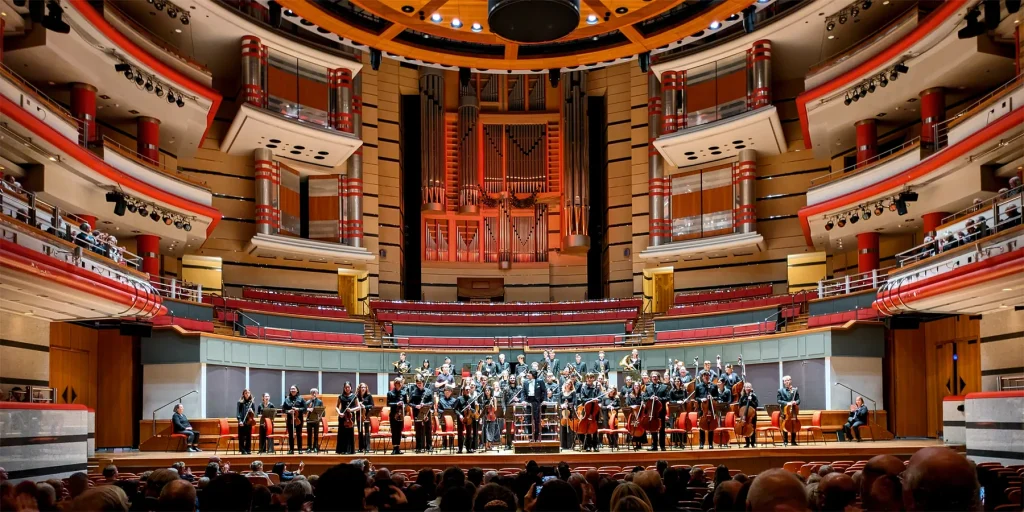
The arrangement of musicians in a symphony orchestra is crucial to the quality of a performance. A modern orchestra has around 88 musicians. They are divided into instrument families: strings, woodwinds, brass and percussion.
The quieter strings sit at the front. The first violins sit on the left, alongside the second violins and violas. This helps their sound reach the audience.
The louder wind instruments sit behind them. The woodwinds, such as flutes, sit in front of the brass, such as horns. The percussion, including the xylophone, sits at the back.
This orchestral arrangement helps every type of instrument be heard. It also helps the conductor, positioned at the center, coordinate the musicians. To learn more, read this article about the symphony orchestra.
Introduction to symphony orchestra seating
The arrangement of musicians in a symphony orchestra matters greatly. It directly affects the sound and how the musicians interact. Instruments are grouped by family, making it easier for musicians to communicate.
Violins, for example, often sit on the left. This helps project their sound toward the audience. Louder instruments, such as the brass and percussion, sit at the back. This arrangement creates the sound balance needed in concerts.
The arrangement of musicians has changed over time. The addition of new instrument families has enriched the orchestra’s sound. These changes reflect how music and orchestras have evolved.
Instrument families in a symphony orchestra
A symphony orchestra is organized into several instrument families. Each plays an important part in creating harmony. These families are the strings, woodwinds, brass and percussion. Each brings its own sound and musical character.
Strings
Strings form the foundation of the orchestra. They include violins, violas, cellos and double basses. These instruments are essential to rich melodies and harmonies.
Woodwinds
Woodwinds, including the flute and oboe, bring distinctive sounds. They often sit behind the strings. Their expressive range enriches the orchestra.
Brass
Brass instruments, including trumpets and trombones, sit toward the back. They add power and grandeur. The family expanded with new instruments in the nineteenth century.
Percussion
Percussion adds dramatic effects and rhythm. It sits behind the brass. To learn more about percussion, read this article.
How is a symphony orchestra arranged?
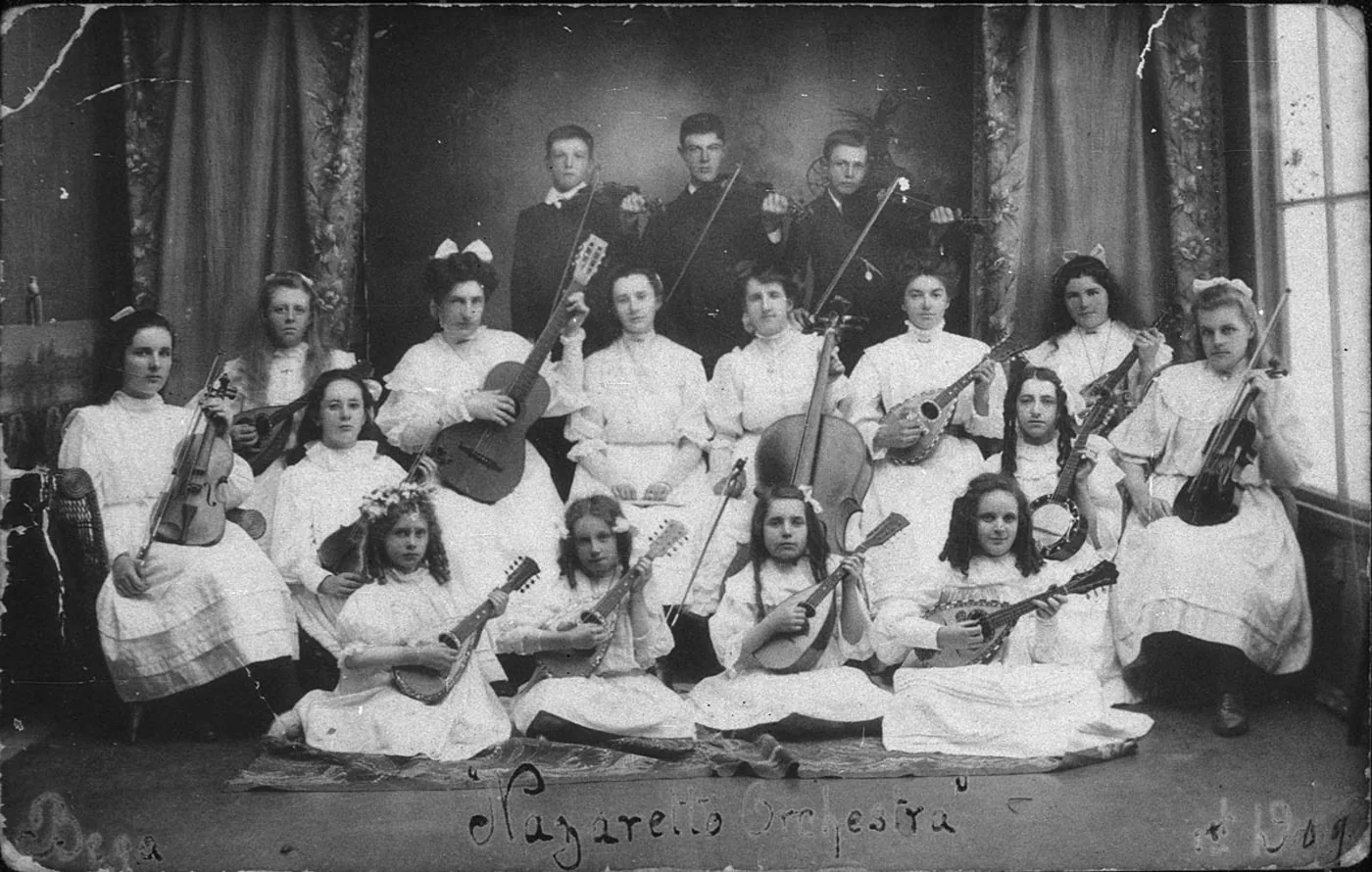
The arrangement of a symphony orchestra matters because it affects what we hear. Musicians are positioned to create a balanced sound and make communication easier.
General placement of musicians
Violins generally sit on the left, while violas, cellos and double basses sit toward the right. This creates a harmonious sound. In 1824, Beethoven used 80 musicians for his Ninth Symphony, with doubled woodwinds.
Nineteenth-century festival orchestras had as many as 130 musicians. Their wind sections were often doubled.
Stage layout and configuration
The orchestra is often arranged in a fan shape. Musicians are positioned so they can see the conductor at the center. This helps them interact during concerts.
Insula orchestra performed with 80 musicians, doubling the woodwinds and trumpets. Different layouts, such as those used in Erfurt and Vienna, affect the sound.
| Type of orchestra | Number of musicians | Period |
|---|---|---|
| Beethoven’s orchestra (1824) | 80 | Classical |
| Mannheim orchestra (1782) | 46 | Classical |
| Esterházy orchestra (Haydn) | 23 | Classical |
| Gurre-Lieder (1913) | 122 | Twentieth century |
| Present-day symphony orchestra | More than 100 | Contemporary |
In short, the arrangement of musicians is designed to create a balanced sound. It also helps musicians interact. Performances by ensembles such as Insula orchestra show how orchestras have evolved.
Each musician’s role in the orchestra
Every musician in an orchestra has a role. Together, they contribute to the beauty and harmony of its sound. Understanding what each musician does helps explain how an orchestra works.
Each section, such as the strings or brass, includes soloists and section players. Soloists play solo passages. Section players play together with the other musicians to create harmony.
Soloists and section players
Soloists play solo passages. Section players play alongside other musicians. Soloists hold an important place in the orchestra.
When a principal player cannot perform, another musician takes their place so the music can continue. Soloists and section players work together to produce a balanced sound.
The concertmaster
The concertmaster leads the orchestra’s musicians. As the leader of the violins, they work closely with the conductor. They help ensure that the instruments are tuned and that musicians communicate with one another.
The concertmaster organizes rehearsals and helps them run smoothly. An outstanding soloist can also demonstrate the importance of this role. To learn more, read this article about the roles of orchestral musicians.
How seating varies between works
The arrangement of a symphony orchestra varies according to the work and the musical period. Baroque orchestras were smaller than those of the nineteenth century. These changes reflect evolving musical styles and the demands of compositions.
Differences between musical periods
Each musical period has its own orchestral requirements. Classical works often follow a traditional structure, while Romantic compositions, such as Berlioz’s, can be more innovative. Changes in orchestral seating reflect the evolution of music. They also show how learning its history can deepen our appreciation of concerts.
How the conductor influences the layout
The conductor plays an important role in arranging the musicians. They may reposition instrumentalists to suit their artistic vision. For example, they might place the strings at the center for a more powerful sound.
This flexibility in seating can reveal new nuances in each performance. It enriches the musical experience and the emotional impact of a work. Conductors such as Berlioz have influenced this flexibility.
FAQ
What is the usual layout of a symphony orchestra?
Why do violins sit on the left of the orchestra?
What are the instrument families in a symphony orchestra?
What is the concertmaster’s role?
How can an orchestra’s seating vary between works?
Do orchestral layouts differ between musical periods?
Source links
- https://human.libretexts.org/Courses/Prince_Georges_Community_College/Music_Appreciation:_A_Topical_Approach_to_Music_Genre_and_Style/02:_Elements_of_Music/2.04:_The_Orchestra
- https://human.libretexts.org/Bookshelves/Music/Music_Appreciation/Music_Appreciation_II_(Kuznetsova)/07:_Musical_Ensembles_Attending_Concerts/7.02:_Symphony_Orchestras
- https://human.libretexts.org/Bookshelves/Music/Music_Theory/Open_Music_Theory_2e_(Gotham_et_al.)/10:_Orchestration/10.01:_Core_Principles_of_Orchestration
- https://human.libretexts.org/Bookshelves/Music/Music_Theory/Open_Music_Theory_2e_(Gotham_et_al.)/10:_Orchestration/10.01:_Core_Principles_of_Orchestration